
English
Views: 0 Author: Site Editor Publish Time: 2026-07-18 Origin: Site


Aluminum windows provide remarkable structural integrity. They feature the slim sightlines highly desired in modern architecture. However, improper joint design or failing seals easily lead to catastrophic moisture infiltration. Many brands casually use "weatherproof" as a marketing buzzword. True water resistance requires an engineered system. Manufacturers must use resilient gaskets, active drainage paths, and rigorous laboratory testing. If moisture breaches your building envelope, you face rapid mold growth. Severe structural degradation follows quickly behind it. You need a skeptical, evidence-based framework to assess these window systems properly. We will equip you with exact technical standards. You will use them to evaluate various manufacturers. You will learn specific questions to ask installers before finalizing your purchase. By understanding these mechanical details, you protect your property from hidden damage. You can buy confidently and ensure long-term structural safety.
Aluminum possesses an absolute material reality. It does not absorb water. Wood can soak up minor moisture without immediate failure. Aluminum strictly repels it. Any moisture breaching the exterior must exit mechanically. If frames lack escape routes, water pools silently inside the wall cavity. You will not notice this pooling immediately. Eventually, it rots the surrounding wood framing.
Temperature changes introduce thermal expansion risks. Aluminum expands and contracts daily. Extreme weather accelerates this movement. Joints and seals must possess high elasticity. If they lack flexibility, micro-gaps form over time. These invisible gaps compromise the entire water barrier. Wind forces push rain directly through these tiny openings into your home.
Failure carries immense structural consequences. Remediation for water damage behind window frames is exponentially expensive. You must tear out interior drywall. You must replace rotting wall studs. You often need extensive mold remediation. This damage costs far more than the premium paid for high-performance windows upfront. You must prioritize performance to avoid these massive repair bills.
Success requires precise environmental alignment. A successful procurement matches the window's water penetration resistance rating to your specific climate. You must evaluate the wind-load exposure of your building. A sheltered suburban home needs different protection than a high-rise coastal condo.
Window seals act as your first and second lines of defense. You must interrogate the manufacturer about their gasket choices. Ask exactly what materials comprise the primary and secondary seals.
Look for EPDM (Ethylene Propylene Diene Monomer) or premium silicone. These materials maintain elasticity across extreme temperature ranges. They repel UV degradation efficiently. They bounce back to their original shape after heavy compression. High-grade EPDM lasts decades without shrinking.
Watch out for major red flags. Many budget manufacturers use thermoplastic elastomers (TPE) or standard PVC. These inferior materials degrade quickly. They shrink under constant UV exposure. They become highly brittle during freezing temperatures. Once they harden, they stop sealing the frame entirely.
| Material Type | UV Resistance | Temperature Flexibility | Expected Lifespan |
|---|---|---|---|
| EPDM / Premium Silicone | Excellent | Maintains high elasticity | 15-20+ Years |
| Standard PVC / TPE | Poor (Degrades easily) | Becomes brittle in cold | 3-7 Years |
You must also inspect the weather seal continuity. Ask if the seals run continuously or if the factory cuts them at the corners. Look for vulcanized corner gaskets. Some manufacturers use injection-molded corners instead. Both options provide an unbroken barrier. Corners remain the most common failure points. When manufacturers merely cut and glue straight gaskets at the corners, water eventually finds a way inside. Capillary action pulls moisture right through degraded corner glue.
Consider the thermal break impact. Modern frames use thermal breaks to stop heat transfer. Ask how this thermal break impacts the water barrier. Look for polyamide thermal struts. These struts must integrate seamlessly into the central weather gasket. This integration creates an unbroken line of defense against moisture. Poorly designed thermal breaks create tiny bridges. Water crosses these bridges straight into the interior frame cavity.
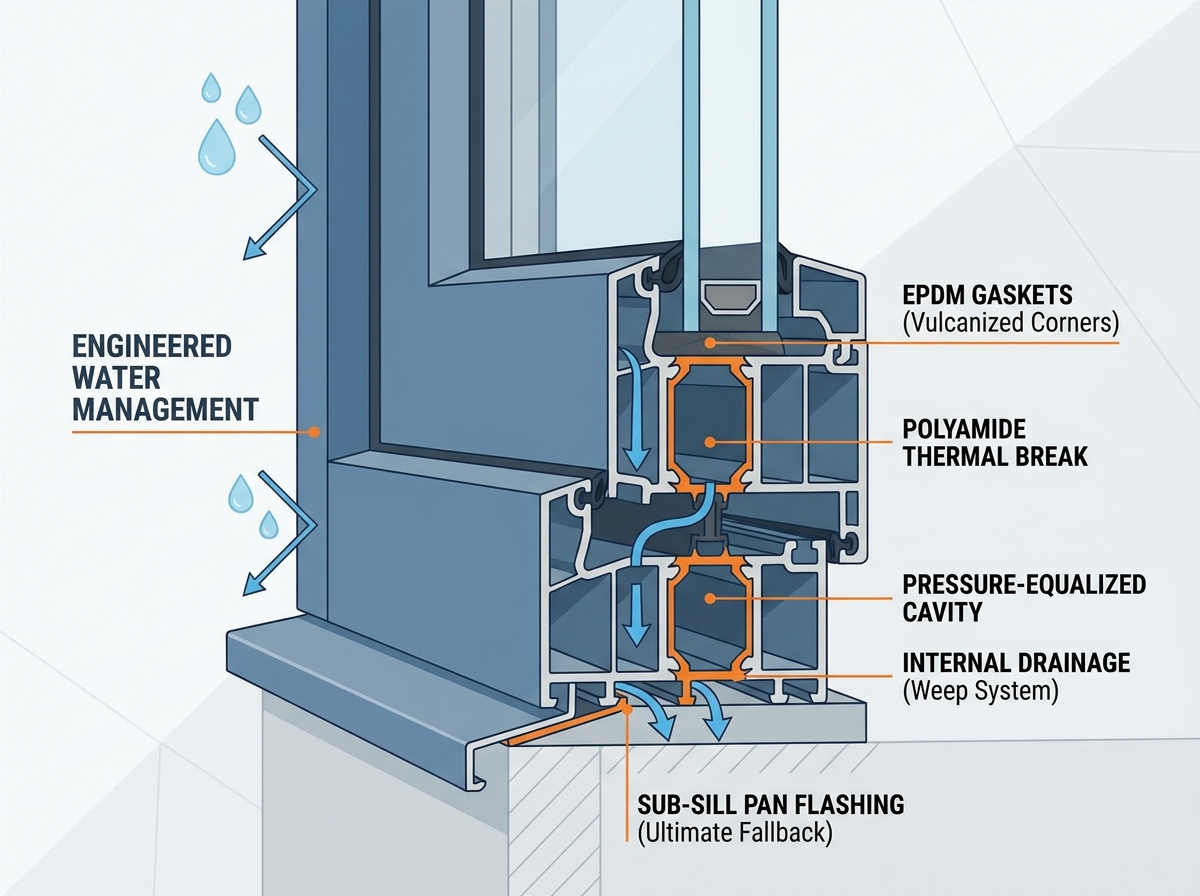
No window blocks every drop of water forever. Effective systems manage the water bypassing the first seal. They rely on sophisticated drainage architecture. You must ask how the frame manages this inevitable moisture.
Look for a multi-chambered frame design. The best frames feature a pressure-equalized cavity. Wind pressure often pushes water inward. A pressure-equalized cavity neutralizes this exterior wind force. It allows gravity to pull the water down naturally. The frame then channels it out harmlessly.
Next, examine the weep holes. Ask if the weep holes sit exposed or remain concealed. Look for concealed drainage systems. If the system uses exposed holes, ensure they feature integrated flapper valves. The industry calls these weep covers. Flappers act as one-way doors. They let water exit the frame safely. They prevent wind-driven rain from blowing back up into the drainage track. Exposed, uncovered holes often fail during hurricanes or intense storms.
Finally, evaluate the drainage track capacity. Ask about the total water volume it can handle. Look for sufficient sill depth. The manufacturer must scale strategically placed drainage slots appropriately. They must handle torrential downpours typical of your local climate zone. A shallow sill overflows quickly during a severe thunderstorm. The overflow dumps water directly onto your interior drywall.
When evaluating water tightness aluminum windows, you must demand objective data. Never accept vague promises of weather resistance. Ask for the window’s Design Pressure (DP) rating for water penetration. Look for a specific numerical value. You will see ratings like DP50 or DP70. Laboratories typically conduct the water penetration test at 15% of the overall design pressure. A DP50 window resists water infiltration up to 7.5 pounds per square foot (psf) of wind pressure. This equals a 54 mph wind driving rain directly against the glass.
Ask if the manufacturer tested the product to AAMA or NFRC standards. International buyers should ask for local equivalent standards. Look for official documentation. The window must pass AAMA 101 laboratory testing. This standard tests water penetration under strict static and dynamic pressure. Some commercial projects also require AAMA 502 field testing. Field testing verifies the performance after physical installation.
Always verify the specific product configuration. Ask if the performance data matches the exact size you plan to buy. Look for transparent testing reports. A fixed picture window naturally achieves a higher water tightness rating. Operable casement windows score slightly lower. Sliding windows of the same product line score the lowest. Ensure the test data matches your specific order. Do not accept a test report for a fixed window if you intend to buy a massive sliding door.
Even the most engineered frame fails if installed incorrectly. You must question your installer rigorously. Ask if the installer will use a rigid or flexible sill pan flashing. Look for a continuous, sloped sub-sill pan. It must feature a rear dam. It must include end dams. This pan acts as your ultimate fallback. If the window frame fails, the pan catches the water. If the perimeter caulking degrades, the pan directs moisture outside.
Ask how the installer isolates the aluminum frame. They must protect it from the surrounding building envelope. Look for thorough compatibility checks. The installer must match the aluminum extrusion to the perimeter sealants. They must ensure compatibility with the weather-resistant barrier (WRB). Incompatible sealants fail to adhere properly. Sometimes they chemically degrade the aluminum finish. This creates direct pathways for water to enter your walls.
Ask about post-installation verification. Do they perform on-site water testing? Look for installers willing to conduct localized hose testing. The best crews perform formal AAMA 502 field testing. They do this before the interior drywall and trim go up. Finding a leak before finishing the interior saves thousands of dollars. It provides ultimate peace of mind.
You need a ruthless shortlisting process. Follow these specific steps to narrow down your options securely:
Choose brands offering joint manufacturer-installer warranty protection. Look for certified installer programs. These programs ensure the manufacturer stands behind the final installed product.
Take action by bringing a technical checklist to your next vendor meeting. Ask them to show you the cross-section of their thermal struts. Request the formal DP rating documentation for the exact operable windows you want. If the vendor dodges these technical questions, find a new supplier.
A: Baseline ratings depend entirely on your local climate. A DP30 rating serves as the absolute minimum for standard residential homes in mild areas. If you live in a coastal zone or a high-wind region, you must demand DP50 or higher. This ensures the frame withstands hurricane-force winds driving heavy rain against the glass. Always verify local building codes before purchasing.
A: Yes, they do by design. Sliding windows rely on brush seals and active drainage tracks to manage moisture. This makes them inherently more vulnerable to wind-driven rain. Casement or awning windows use compression seals. When wind blows against a casement window, it pushes the sash tighter into the weather stripping. This creates a superior, watertight seal during storms.
A: High-quality EPDM or silicone weather stripping easily lasts 15 to 20 years under normal conditions. However, you should perform visual inspections every five years. Look closely for shrinkage, brittleness, or cracking in the corners. If you notice drafts or find moisture pooling on the sill, replace the gaskets immediately to maintain peak performance and protect your walls.