
English
Views: 0 Author: Site Editor Publish Time: 2026-07-12 Origin: Site


Industry professionals often confuse outward-opening window configurations. Top hung and awning variations appear identical from a distance. They both hinge at the top header. They both push outward from the sill.
However, this identical geometry hides crucial mechanical differences. Terminology usually dictates distinct hardware choices. You might specify a crank mechanism or a manual push-out system. These mechanical differences impact load capacities directly. They also define suitable architectural applications. Specifying the wrong type causes compromised ventilation. It can lead to early hardware failure. It might also increase unnecessary project costs.
This article delivers a strict, technical evaluation. We explore how a top hung aluminum window differs from a traditional awning design. You will learn about mechanical variations and performance limits. We also guide your final procurement decisions. You can confidently select the right system for your next project.
You must understand the shared geometry first. Both window styles pivot from the top header. They project outward into the exterior space. This design creates a canopy effect. It protects interiors during inclement weather. However, the similarities end there. The actuation mechanics separate them entirely.
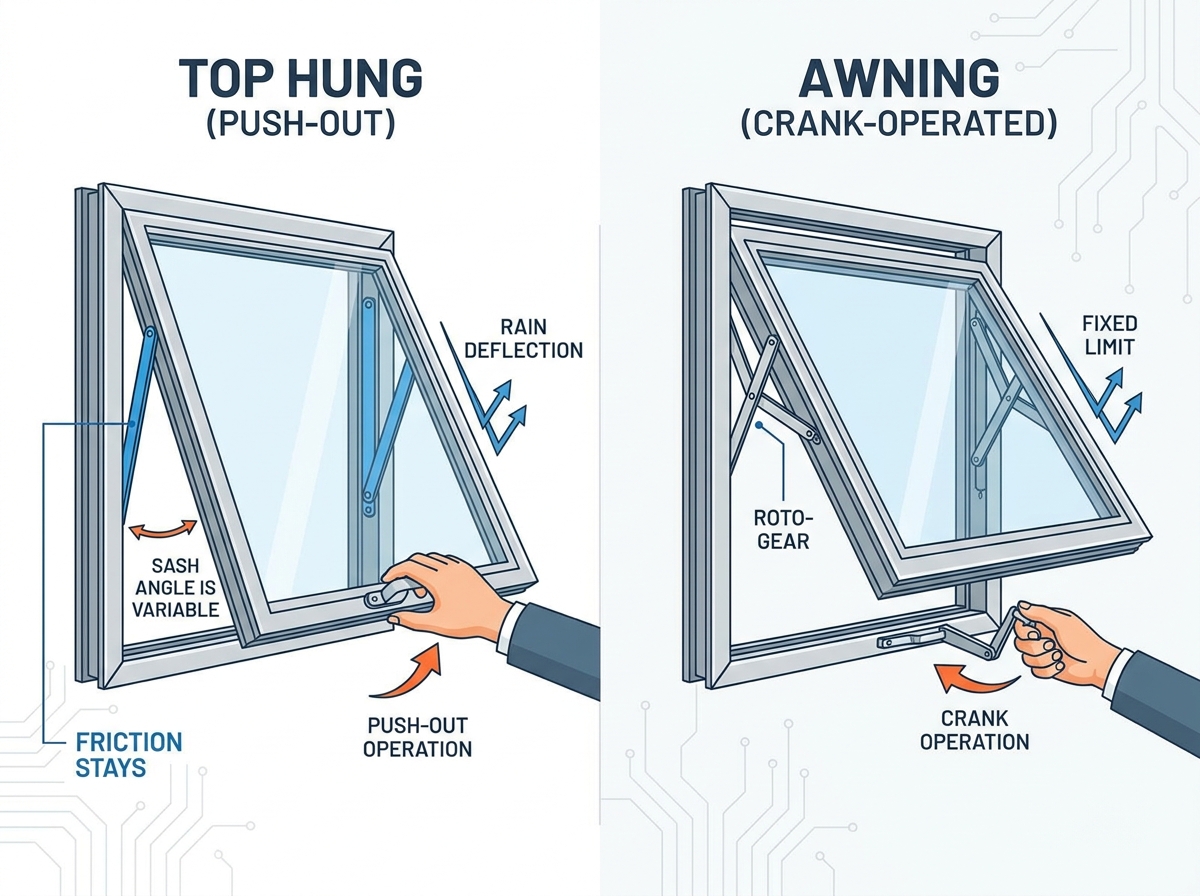
A top hung aluminum window relies on friction stays. These stainless steel hinges sit on the vertical sides. Users operate them manually. You grab a cam handle, push the sash out, and lock it. The friction within the side stays holds the window open. You can achieve variable opening angles. The angle depends entirely on the hinge tension. This push-out mechanism requires direct physical access.
An awning aluminum window uses a different approach. It relies on a mechanical scissor-arm operator. Sometimes, it uses a chain-winder located at the sill. You operate it via a folding hand crank. You rotate the crank to deploy the scissor arm. This arm pushes the sash outward. Awnings have a fixed maximum opening radius. The mechanical arm length strictly dictates this limit.
Hardware Mechanics Summary
| Feature | Top Hung (Push-Out) | Awning (Crank/Roto-Gear) |
|---|---|---|
| Actuation Mechanism | Manual push-out via cam handle | Rotary crank via scissor-arm |
| Hinge Type | Side-mounted friction stays | Top-mounted hinges |
| Opening Radius | Variable (tension dependent) | Fixed (arm length dependent) |
| Operator Location | Bottom sash rail | Bottom sill frame |
Both styles perform exceptionally well against the elements. They offer superior weatherproofing compared to sliding units. Their outward-opening nature creates a structural advantage against wind.
Thermal and weather resistance remains high. Both utilize dense compression seals. Engineers typically specify EPDM rubber gaskets for these systems. Positive wind pressure pushes the sash inward. It presses tightly into the frame. This action actively tightens the seal. Sliding windows cannot replicate this compression sealing. You also get excellent rain deflection. Both windows act like a structural canopy. You can leave them open during light rain. However, extreme outward angles on top hung variations might catch severe updrafts.
Ventilation efficiency requires careful consideration. Both designs capture bottom-up airflow effectively. They draw cool air inside. They let warm air escape near the top. But a strict limitation exists. Neither style provides 100% full-aperture ventilation. A casement window opens fully sideways. Top-hinged designs permanently block a portion of the aperture.
Security and locking systems also diverge. You must integrate multi-point locking for high security. Crank awnings typically lock at the sides. They use a single lever connected to a tie-bar. A top hung aluminum window offers more robust options. They frequently feature espagnolette locking systems. These systems throw multiple locking cams into the frame. They provide much higher forced-entry resistance.
Performance Metric Chart
| Performance Metric | Top Hung Design | Awning Design |
|---|---|---|
| Wind Load Resistance | Excellent (High capacity) | Good (Moderate capacity) |
| Rain Deflection | Very Good | Excellent |
| Aperture Ventilation | Moderate | Moderate |
| Forced-Entry Resistance | High (Espagnolette locks) | Standard (Tie-bar locks) |
Application context drives your hardware choice. Commercial structures demand different tolerances than residential homes. You must match the window mechanics to the building requirements.
You should specify a top hung aluminum window for high-rise projects. They dominate commercial glazing. Heavy-duty friction stays offer superior wind-load capacity. They support massive aluminum frames easily. They handle larger, heavier double or triple-glazed sashes. Friction stays distribute the glass weight evenly across the jambs. Modern architectural design also favors them. They provide exceptionally clean interior sightlines. You avoid bulky crank hardware protruding from the sill.
Conversely, you should specify awning windows for residential access. They excel in hard-to-reach areas. Kitchens frequently utilize them. You often place windows over deep counters or appliances. Reaching across a counter to push a sash outward strains the user. A sill-mounted crank solves this accessibility problem entirely. Awnings also offer precise control. You adjust ventilation incrementally by turning the handle. You do not need to lean outside to pull the sash closed.
Every mechanical system carries inherent failure risks. Recognizing these risks prevents costly maintenance issues downstream. Hardware degrades differently based on user behavior and environmental stress.
Hardware failure points vary significantly between the two types. Awning windows suffer from user error. People often try forcing the crank while the sash remains locked. They might crank the handle when an exterior object blocks the path. This forces the mechanism. It strips the roto-gears internally. It bends the metal scissor arms permanently. Replacing these gearboxes requires specialized tools.
Top hung systems face different wear patterns. Friction hinges lose tension over time. Heavy winds exacerbate this loosening effect. The sash might suddenly slam shut during a gust. Facility managers must perform manual tightening. They adjust small set-screws on the side stays to restore friction.
Screen integration introduces massive design challenges. Both configurations open outward. Therefore, both require interior-fitted insect screens.
Egress compliance presents a hard boundary. Neither window type normally suits emergency egress requirements. Building codes mandate specific clear opening geometries for bedrooms. Fixed mechanical arms block the escape aperture. Friction stays restrict the opening angle. You must verify local fire codes before specifying these in sleeping quarters.
Selecting the correct configuration requires a methodical approach. Do not guess based on aesthetics alone. Use this structured decision framework to evaluate your specific project parameters.
By following these steps, you mitigate specification errors. You align user expectations directly with hardware realities.
The choice between a top hung aluminum window and an awning window rarely involves the frame material itself. Aluminum extrusions perform identically in both scenarios. The decision hinges entirely on actuation hardware. You choose between manual friction stays and mechanical roto-gears. Each mechanism serves distinct structural and ergonomic needs.
Top hung units dominate commercial applications due to strength and clean lines. Awning configurations rule residential spaces needing precise, accessible ventilation. Your next step involves gathering technical data. Review hardware specification sheets thoroughly. Verify your local egress codes regarding clear opening requirements. Finally, request a physical hardware mockup from your glazing contractor. Test the operation resistance firsthand. Verify the screen compatibility before finalizing your procurement order.
A: Structurally, yes (they are both top-hinged). Mechanically, no. "Top hung" usually means push-out friction hinges, while "awning" means crank-operated.
A: Yes, for light to moderate downward rain. Wind-driven rain can still enter if the angle of projection is severe.
A: Awning windows can have higher initial hardware costs due to the roto-gear mechanisms. However, commercial-grade top hung friction stays for large spans often equalize or exceed residential awning costs.
A: Cleaning the exterior glass from the inside is notoriously difficult for both types. Standard practice requires exterior access or specialized drop-hinge hardware designed specifically for maintenance.