
English
Views: 0 Author: Site Editor Publish Time: 2026-07-23 Origin: Site


Selecting glazing for aluminum windows directly impacts building security. It also affects acoustic performance, occupant safety, and code compliance. Aluminum frames offer incredible structural rigidity for modern homes and commercial buildings. However, the glass panels dictate window performance under extreme stress. These stresses include physical impact, forced entry, and severe weather.
Property owners face a critical choice when configuring these modern framing systems. Making the wrong glazing selection compromises forced entry resistance. It also severely limits sound insulation and general weather protection. You must understand how different glass types behave upon impact to make a sound architectural investment.
This article provides a clear, evidence-based decision framework to guide your selection. We evaluate failure patterns, critical performance metrics, and aluminum frame compatibility. You will learn exactly how to approach the tempered vs laminated glass debate. We cover everything needed to choose the perfect safety glazing for your specific project.
Understanding the fundamental mechanics of glass failure remains essential for architectural planning. Each safety glazing option utilizes distinct manufacturing processes. These processes completely change their physical behavior under extreme duress.
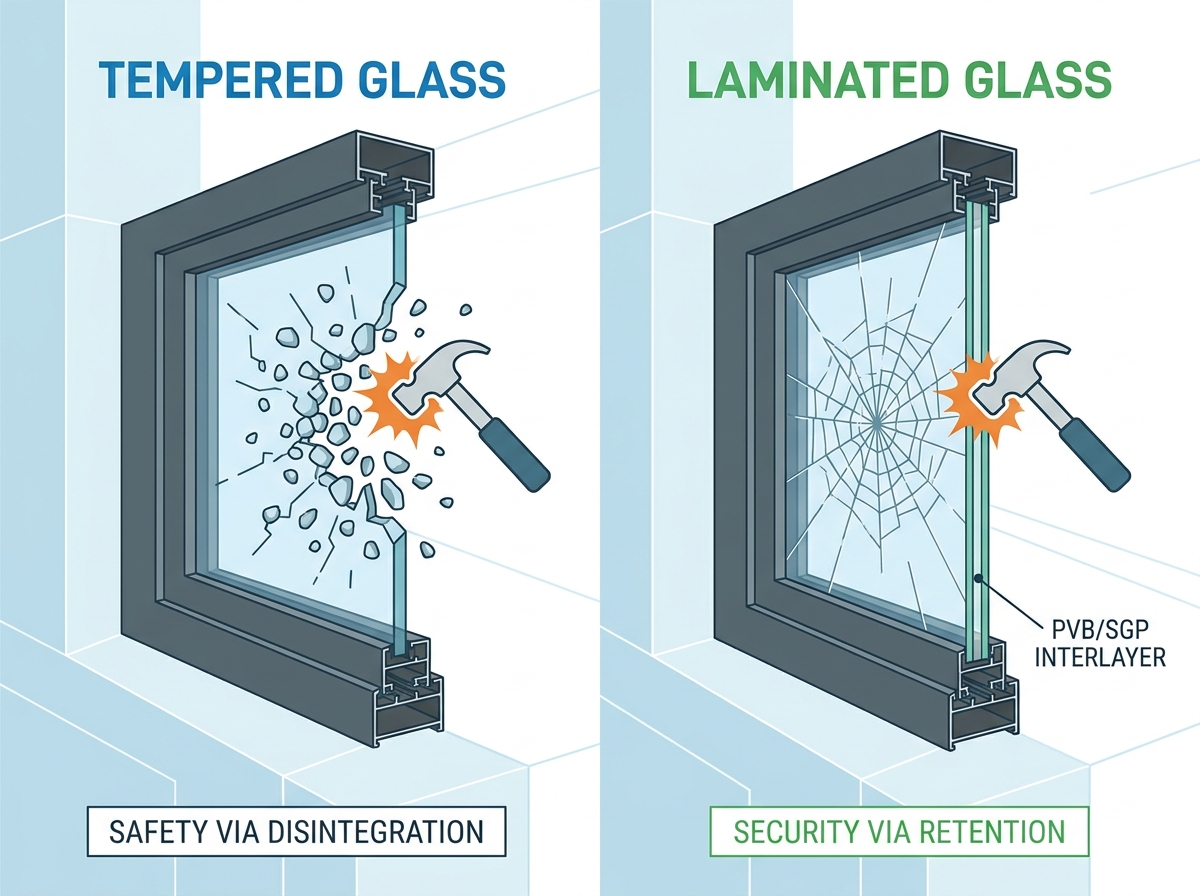
Manufacturers create tempered safety glass through a rigorous thermal tempering process. They subject standard annealed glass to rapid heating inside a specialized furnace. The glass then undergoes immediate forced cooling. This rapid temperature change alters the internal stress profile of the pane. It compresses the outer surfaces while creating tension in the core. The resulting product becomes four to five times stronger than standard glass.
The failure state defines its primary safety characteristic. When broken, it instantly shatters into small, relatively harmless granular chunks. These blunt pebbles rarely cause deep lacerations. They protect occupants from severe injury during accidental human impact. However, this disintegration presents a critical limitation. It leaves the window opening completely exposed. Wind, rain, or intruders can easily enter the building once the pane shatters.
Laminated glass takes a completely different engineering approach. It comprises two or more plies of glass. A thermoplastic interlayer bonds these separate panes together under immense heat and pressure. Manufacturers typically use Polyvinyl Butyral (PVB) or SentryGlas Plus (SGP) for this central core.
Its failure state prioritizes structural retention over harmless disintegration. The glass fractures upon severe impact. It forms a distinct spiderweb pattern across the surface. However, the broken pieces remain firmly adhered to the flexible interlayer. This mechanism offers a massive structural advantage. It maintains the building envelope entirely. It prevents immediate weather ingress during storms and halts physical entry attempts dead in their tracks.
Safety glazing serves multiple functional roles beyond mere impact resistance. You must evaluate how each option performs across three critical dimensions. These dimensions include physical security, acoustic insulation, and ultraviolet light control.
Security protocols demand glazing resisting active human attacks. Tempered glass performs poorly against targeted intrusion attempts. Intruders bypass it in seconds using a concentrated strike. Burglars frequently use spring-loaded center punches to shatter the entire pane instantly. The granular disintegration clears the pathway immediately.
Laminated glass significantly delays active intrusion. Attackers must use repeated, high-energy impacts to breach the tough polymer interlayer. Even after the glass plies shatter, the PVB or SGP core stretches and holds firm. This delay tactic forces criminals to abandon the attempt due to noise and effort. It proves ideal for ground-floor installations and hidden entry points.
Noise pollution severely impacts occupant comfort in urban environments. The building industry measures acoustic performance using Sound Transmission Class (STC) and Outside-Inside Transmission Class (OITC) ratings. Tempered glass offers no meaningful sound reduction. It performs identically to standard annealed glass acoustically.
Laminated glass naturally dampens sound vibration. The PVB layer acts as an exceptional acoustic buffer. It effectively reduces high-frequency noise transmission. You will notice significant drops in traffic noise and siren disruptions. Integrating laminated panels elevates the window unit's overall STC rating substantially.
Prolonged sunlight exposure damages valuable interior assets. Standard tempered glass allows massive ultraviolet transmission. This exposure risks severe interior fading over time. Hardwood floors, expensive carpets, and custom furniture suffer irreversible damage.
Laminated glass blocks up to 99% of transmitted UV light. The internal thermoplastic interlayer functions as a permanent sunscreen for your building. This protects valuable furnishings and critical commercial retail displays. It offers effortless preservation for interior investments.
| Performance Dimension | Tempered Glass | Laminated Glass |
|---|---|---|
| Impact Resistance | High (4-5x stronger than standard) | Moderate (outer plies may crack easier) |
| Post-Breakage State | Shatters into small blunt pebbles | Cracks but remains adhered to interlayer |
| Forced Entry Delay | Very Low (instant bypass possible) | Very High (requires repeated high-energy strikes) |
| Acoustic Insulation | Poor (no sound dampening advantage) | Excellent (interlayer absorbs vibrations) |
| UV Protection | Poor (allows UV transmission) | Excellent (blocks up to 99% of UV rays) |
You cannot select advanced glazing without assessing the aluminum framing system. The physical properties of the glass dictate the engineering requirements of the surrounding frame. Failing to match these components causes severe operational failures.
Laminated glass weighs significantly more per square foot than standard tempered panels. This added mass introduces distinct structural challenges. A common mistake involves installing thick laminated insulated glass units (IGUs) into standard residential aluminum frames. The sashes eventually drop under the immense weight. Standard hinges and rollers sag over time. This sagging causes severe locking issues and compromises weatherstripping.
You must assess the aluminum extrusion profile carefully before ordering. Multi-layer laminated configurations require much deeper glazing pockets. Standard tempered panes use thinner overall profiles. You must ensure the frame geometry can accommodate the extra thickness. Forcing thick glass into narrow pockets damages the thermal breaks and ruins the exterior seals.
Specifying heavier glazing necessitates immediate hardware upgrades. You often need commercial-grade tandem rollers for large sliding windows. Heavy casement windows require robust multi-point locking hinges. We highly recommend specifying stainless steel friction stays for top-hung windows. These heavy-duty components prevent operational failure. They ensure long-term ease of use despite the massive pane weight.
Regulatory frameworks and project budgets heavily influence final architectural decisions. Understanding how building codes treat these materials prevents costly inspection failures. Analyzing upfront costs ensures proper resource allocation.
The International Building Code (IBC) strictly regulates glass installations. Both options satisfy basic safety glazing requirements. The code applies these rules to doors, bathrooms, and floor-to-ceiling windows. These hazardous locations require glass behaving safely upon human impact. Tempered disintegration and laminated retention both pass standard IBC safety tests.
However, geography changes the legal requirements entirely. Hurricane and coastal zones frequently mandate laminated impact-rated glass by law. Severe weather regions require envelopes surviving extreme wind pressures and flying debris. You cannot legally install tempered glass in many coastal High Velocity Hurricane Zones (HVHZ).
Upfront costs differ drastically between the two technologies. Tempered glass remains a highly commoditized product globally. Sourcing it proves significantly cheaper for large-scale projects. Laminated glass carries a noticeable cost premium. Complex manufacturing procedures and expensive polymer interlayers drive this higher price point.
You must also consider the replacement reality for each type. Tempered glass requires full IGU replacement upon a single break. The window remains boarded up until the new unit arrives. Laminated glass technically requires a full swap eventually. However, it remains structurally sound temporarily after fracturing. It secures the building while you schedule a professional replacement. This temporary security provides immense practical value for commercial properties.
The choice between these two glazing technologies requires a systematic approach. You must align the glass properties against your specific architectural priorities. Use the following framework to guide your final specification.
Modern building science offers an optimal compromise. Consider specifying advanced insulated glass units. They combine both technologies effectively in a single frame. You use one pane of tempered glass on the exterior face. This handles basic physical impact and temperature fluctuations safely. You place one pane of laminated glass on the interior face. This provides secondary security, UV protection, and superior sound dampening. This hybrid configuration maximizes overall window performance while balancing the budget.
The debate between these advanced glazing types lacks a universal winner. You must align the choice against your specific risk profiles. Architectural constraints and environmental factors dictate the final decision. Tempered panels deliver affordable, code-compliant safety for standard applications. Laminated panels provide uncompromising security, acoustics, and envelope protection.
Your next steps require careful project evaluation. Verify your local building codes regarding safety glazing and wind-borne debris first. Assess the load-bearing capacity of your selected aluminum profiles carefully. Finally, prioritize your functional goals based on the triad of budget, security, and noise reduction. Following these steps ensures a successful, high-performance window installation.
A: Tempered glass cannot be cut or drilled after manufacturing; it will shatter immediately. Laminated glass can technically be cut by professionals using specialized tools, but it is highly complex and rarely done on-site to avoid delamination risks.
A: No. While 3M or security films improve fragment retention and delay entry, factory-bonded laminated glass offers superior structural integrity, longevity, and acoustic benefits without the risk of peeling or bubbling over time.
A: No window is 100% soundproof. Laminated glass significantly reduces noise transmission, but overall acoustic performance also depends on the aluminum frame's thermal breaks, weatherstripping, and installation quality.
A: The outer glass plies of a standard laminated unit may crack under less force than tempered glass, but the system as a whole will not fail or fall out of the frame.