
English
Views: 0 Author: Site Editor Publish Time: 2026-08-26 Origin: Site


Every architectural project faces a common, unavoidable dilemma. You must balance upfront material expenses against long-term facade integrity and maintenance liabilities. As buildings age, exterior surfaces bear the brunt of environmental damage. Polyvinylidene fluoride, widely known as PVDF, offers a proven solution to this problem. It is an architectural liquid resin coating commonly recognized by industry-leading trade names like Kynar 500® or Hylar 5000®. This advanced coating sits firmly at the absolute top of the performance hierarchy for architectural metals. However, while specifying PVDF aluminum windows delivers unparalleled durability, they are not strictly necessary for every single project. Choosing the right finish requires careful analysis of site conditions, budget constraints, and aesthetic goals. This guide gives you an evidence-based framework. You will learn exactly when the premium cost of PVDF is justified. We will explore its chemical properties, compare it against popular alternatives, and identify the specific environmental scenarios demanding top-tier protection.
To truly understand PVDF, we must look closely at its underlying chemical composition. Optimal weatherability requires a standard 70% PVDF resin ratio by weight. The remaining 30% consists of proprietary acrylic resins and durable inorganic pigments. This specific blend allows manufacturers to meet strict industry standards reliably. Two prominent benchmarks dictate architectural finishes: AAMA 2605 in North America and AS3715 in Australia. These standards demand rigorous testing. They require materials to withstand ten years of South Florida weathering, along with 4,000 hours of continuous salt spray exposure.
The secret to this incredible resilience lies in the carbon-fluorine bond. It ranks among the strongest chemical bonds found in nature. This dense molecular bond resists photodegradation far better than alternative polymers. Standard polyesters break down under constant solar radiation, losing their glossy appearance. PVDF maintains its structural integrity seamlessly. Over a 10-to-20-year period, performance metrics show minimal color change. We measure this fade using the Delta E scale. A lower Delta E value means the naked eye cannot detect fading. PVDF consistently scores within acceptable, nearly imperceptible margins.
Furthermore, PVDF resists harsh environmental attacks efficiently. Airborne pollutants, urban smog, salt spray, and acid rain degrade inferior finishes quickly. PVDF acts as an inert, impenetrable barrier against these corrosive elements. We avoid calling any architectural material indestructible. However, objective testing proves PVDF handles industrial atmospheres exceptionally well. It limits surface chalking and prevents the underlying aluminum from suffering microscopic pitting.
Architects and builders usually choose between PVDF, standard powder coating, and anodizing. Each option presents distinct advantages and specific limitations. The initial application cost of PVDF runs notably higher than standard powder coating or conventional anodizing. You must weigh this premium against expected maintenance intervals. A cheaper upfront finish might require complete repainting after a decade of sun exposure. PVDF extends these maintenance intervals significantly. It reduces long-term lifecycle expenses by delaying the need for costly exterior renovations.
When you need aesthetic flexibility, PVDF leads the pack decisively. It achieves vibrant, custom colors effortlessly. You can also specify complex metallic finishes, mica flakes, and exact corporate brand colors. Anodizing, by contrast, relies on a sensitive electrochemical process. This sulfuric acid bath sometimes causes frustrating batch-to-batch color variations. A dark bronze anodized window frame might look slightly different than the one installed next to it. PVDF guarantees uniform color consistency across massive, multi-story facade elements.
We must also address the environmental impact of these materials. Liquid PVDF applications contain Volatile Organic Compounds (VOCs). They require solvents for liquid dispersion. Standard powder coatings remain entirely solvent-free. This gives architectural powder an undeniable ecological edge during application. However, modern factory capture systems mitigate PVDF environmental concerns effectively. Advanced thermal oxidizers intercept and destroy harmful VOCs before they ever leave the factory exhaust stack.
| Finish Type | Initial Application Cost | Color Consistency | Expected Maintenance Interval | Primary Industry Standard |
|---|---|---|---|---|
| PVDF (70% Resin) | Premium | Excellent | 20 to 30+ Years | AAMA 2605 |
| Super Durable Powder | Moderate | Good | 10 to 15 Years | AAMA 2604 |
| Class I Anodized | Moderate | Variable | 15 to 20 Years | AAMA 611 |
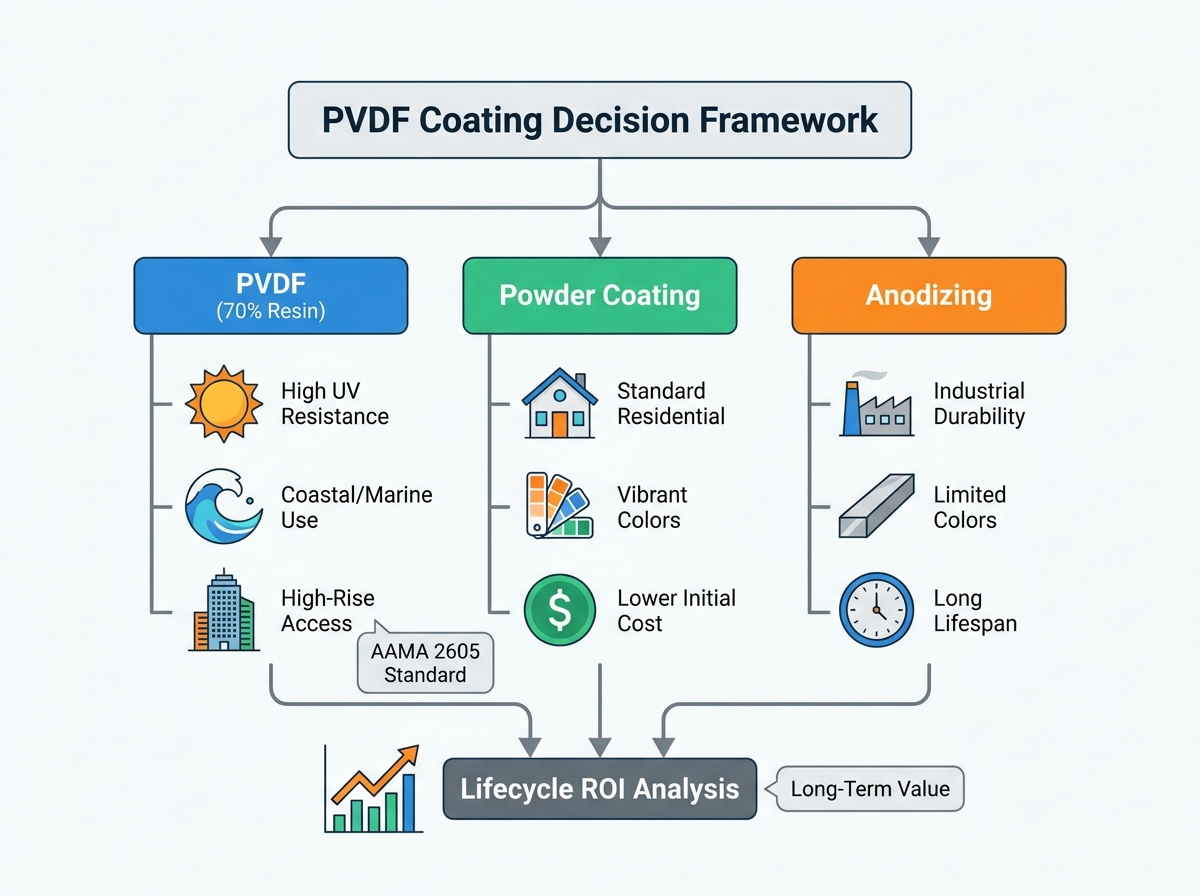
Certain site conditions leave no room for compromise. In these high-risk scenarios, specifying PVDF aluminum windows shifts quickly from an architectural luxury to a structural necessity.
Coastal and marine environments demand aggressive protection. Saltwater causes rapid galvanic corrosion in unprotected metals. Industry guidelines dictate specifying PVDF for buildings located within one mile of saltwater. This coating requires proper chrome or non-chrome pre-treatment to stop aggressive salt spray penetration. Without it, the aluminum substrate will oxidize and push the paint off the frame.
High-rise and monumental commercial structures present very different logistical challenges. We look at the return on investment based purely on access limitations. Scaffolding, swing stages, and specialized hydraulic lifts cost thousands of dollars a day to rent. If you must use a crane to access and repaint a 40-story glass curtain wall, the upfront PVDF premium becomes an operational necessity. You want to touch the facade as infrequently as possible.
Geography also dictates material choices heavily. Extreme UV exposure quickly degrades standard polyesters. Regions close to the equator, desert climates, or high-altitude locations face constant, intense solar radiation. Standard finishes exhibit heavy chalking and fading within just five years under these harsh skies. PVDF resists this intense UV bombardment, keeping the building envelope looking new.
Finally, high-end custom residential projects frequently mandate PVDF finishes. This represents an aesthetic protection choice. Bespoke, dark colors like charcoal, jet black, or deep navy show chalking prominently. Homeowners investing heavily in large sliding glass doors or custom bi-fold systems expect pristine, museum-quality facades. PVDF ensures those deep shades remain vibrant and refuse to turn a milky, chalky white over time.
Even the most advanced chemical formulations can fail in the field. Demonstrating true expertise means acknowledging these harsh realities and understanding the precise technical mechanisms behind them. When a PVDF system fails, the fluoropolymer chemistry rarely takes the blame. Human error, factory oversights, and poor quality control cause most visible defects.
You cannot simply order a chemical name on a blueprint. You must manage the entire application supply chain carefully. Doing so prevents disastrous, costly field failures.
Clear, airtight documentation protects your project from day one. Ambiguous or vague specifications invite cheaper, low-performing material substitutions from aggressive contractors. You must explicitly define your performance expectations in the architectural plans.
Specifying PVDF aluminum windows represents a highly calculated investment in the future of your building. It dramatically reduces lifecycle replacement expenses and rigorously preserves your intended architectural aesthetics. By choosing a high-performance fluoropolymer, you avoid premature chalking, noticeable color shifts, and the massive financial burden of expensive facade repainting. Always match your coating specification strictly to the environmental data of the project site. Take time to analyze local UV indexes, coastal salt proximity, and total building heights. We strongly advise consulting with an experienced engineering or architectural sales team early in the design phase. They will review your project blueprints carefully and assess your site conditions. Together, you can verify if a premium PVDF finish offers the structurally and financially optimal choice for your specific development.
A: PVDF typically commands a 20% to 40% initial cost premium over standard architectural powder coatings. This specific range fluctuates heavily based on color complexity. Standard solid colors fall on the lower end of the spectrum. Conversely, custom metallic finishes, micas, or bright bespoke shades require complex pigment formulations and multiple coating passes, pushing the application price significantly higher.
A: Yes, but you must manage your expectations carefully. Factory-baked PVDF cures at extremely high temperatures to achieve maximum durability. Field touch-ups rely on air-dried acrylic or fluoropolymer touch-up paints. These air-dried paints lack the same robust chemical resilience. They may also show slight color and gloss variations over time as they weather differently than the original factory finish.
A: A properly applied and cured PVDF finish realistically lasts 20 to 30 years or more. This longevity depends heavily on local environmental exposure and routine maintenance. High-UV regions or harsh coastal environments may see the lower end of this performance range. Regular annual washing removes corrosive pollutants and significantly extends the architectural coating's functional lifespan.
A: Yes, it requires an annual wash-down using mild soap and clean water. You must remove accumulated dirt, salt deposits, and industrial pollutants to maintain your warranty validity. Never use abrasive cleaning pads, strong acids, or harsh alkaline solutions on window frames. These aggressive chemicals will permanently scratch, etch, or degrade the protective fluoropolymer resin surface.