
English
Views: 0 Author: Site Editor Publish Time: 2026-07-17 Origin: Site


Aluminum window frames offer superior structural integrity for modern commercial and residential buildings. However, their inherent rigidity introduces distinct performance challenges over time. Unless properly secured across the entire sash, this rigidity can easily compromise crucial weather seals and overall building security.
Single-point locks on tall or wide aluminum windows often leave top and bottom corners highly vulnerable. These exposed extremities succumb quickly to thermal bowing during extreme temperature shifts. Consequently, they invite persistent drafts, allow moisture intrusion, and create obvious physical vulnerabilities for forced entry.
This article provides a transparent, technical evaluation framework for professionals. We will guide you through selecting and implementing locking hardware for aluminum systems. You will learn to prioritize critical performance outcomes. Furthermore, we will explore the practical installation realities you must navigate to ensure long-term, fail-safe reliability.
Modern architecture heavily favors large aluminum fenestration. Builders love the slim sightlines and incredible durability. Yet, large sashes present a unique physical physics problem. You must manage how the frame interacts with environmental forces.
Aluminum reacts actively to extreme temperature differentials. When the exterior face bakes in the summer sun, it expands. Meanwhile, the air-conditioned interior face remains cool and contracted. This temperature delta forces the window sash to bow outward at its extremities. A single-point lock simply anchors the center of the sash. The top and bottom corners pull away from the frame. This deflection breaks the perimeter weather seal. It allows rain and wind to penetrate the building envelope. Multiple locking points actively distribute clamping force along the entire sash height. They forcibly hold the corners against the frame. This continuous pressure maintains vital gasket compression regardless of thermal expansion.
Security goes beyond adding thicker glass. Intruders rarely break modern tempered panes. Instead, they target the frame with leverage tools. A crowbar inserted near the corner of a single-point window easily defeats the central latch. The rigid aluminum acts as a giant lever against the solitary lock point. multi point lock windows eliminate this leverage advantage. They distribute applied force across multiple independent locking zones. Prying the bottom corner no longer threatens the main latch. This distributed resistance is necessary for compliance. Industry testing frameworks strictly mandate it. AAMA forced entry standards and European PAS 24 certifications both require this multi-point force distribution to pass their rigorous leverage tests.
Professionals often view locking hardware purely as a security feature. However, it plays a critical role in environmental control. Achieving targeted U-values requires absolute air tightness. STC (Sound Transmission Class) ratings demand identical conditions. Sound waves and winter drafts exploit the same microscopic gaps. If a window sash lacks uniform perimeter pressure, acoustic gaskets cannot compress evenly. Upgrading to a multi-point mechanism ensures a continuous, airtight perimeter seal. It transforms the hardware from a simple security device into an active energy-efficiency component.
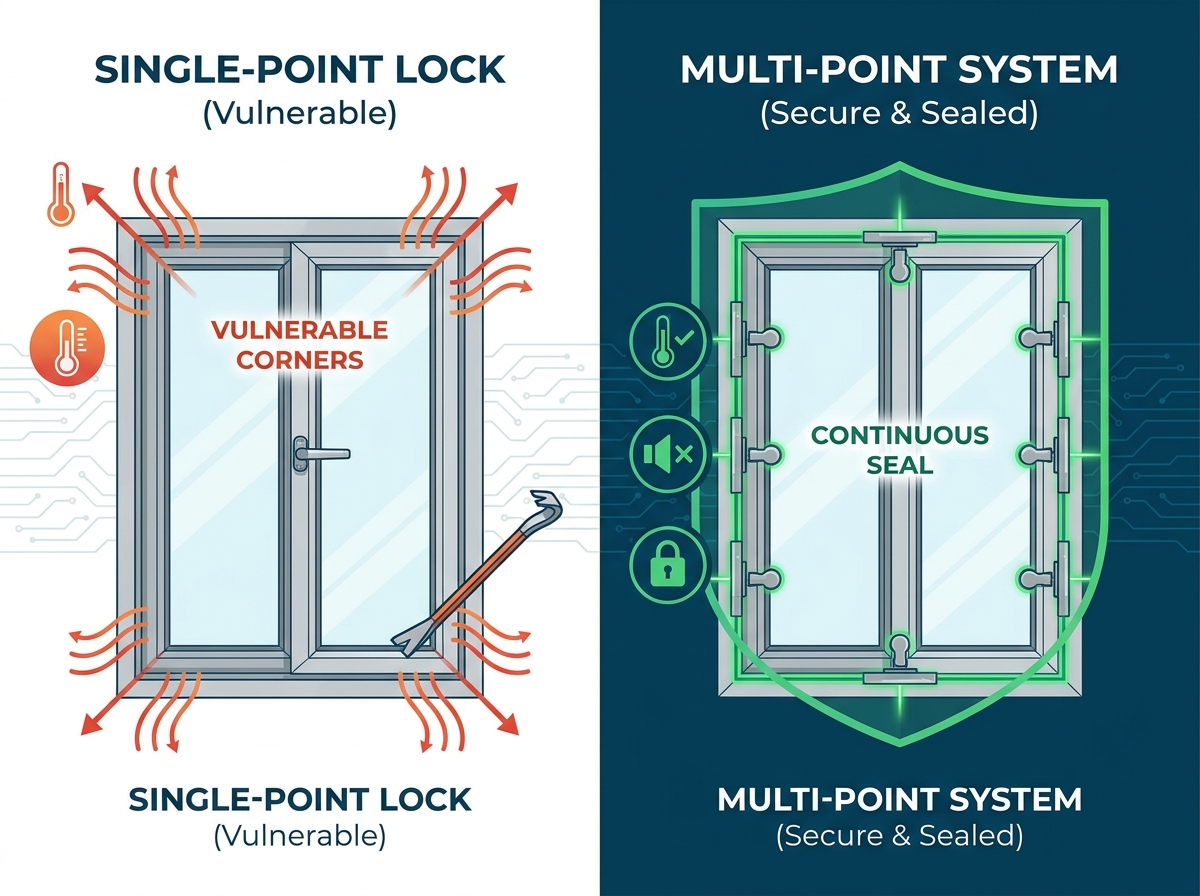
Window manufacturers utilize several distinct locking mechanisms. Each design addresses specific operational types and structural demands. You must align the mechanism with your specific window profile.
Below is a summary chart comparing the primary locking mechanisms.
| Mechanism Type | Primary Engagement | Best Application | Key Limitation |
|---|---|---|---|
| Mushroom Cams | Sliding into keeps | Casement & Tilt-Turn | Requires frequent fine-tuning |
| Hook & Claw Bolts | Pivoting into strike plates | Heavy-duty Security | Higher initial operational force |
| Shootbolt Systems | Extending into top/bottom frames | Tall Casement Windows | Needs deep frame clearances |
Mushroom cams represent the most common locking hardware for standard applications. They feature cylindrical or mushroom-headed metal pins. These pins attach to a sliding drive rod along the sash edge. When you turn the handle, the rod slides. The cams engage tightly into frame-mounted keeps. The mushroom shape prevents the sash from being pulled outward. They work exceptionally well for standard casement and tilt-turn windows. They offer excellent, adjustable compression. However, they carry specific limitations. They often require precise fine-tuning post-installation. If the cams sit too tight against the keeps, the window handle becomes incredibly stiff.
Hook systems deliver a completely different physical engagement. Instead of sliding laterally, heavy metal hooks pivot outward. They rotate directly into fortified strike plates on the frame. This pivoting motion actively grips the keep. It physically prevents the sash from being pried laterally away from the frame. Hook and claw bolts provide unmatched leverage resistance. They serve best in heavy-duty aluminum applications. High-risk security environments frequently demand them. The robust design handles heavy sashes effortlessly. They do require wider frame profiles to accommodate the pivoting hook depth.
Shootbolts anchor the window at its absolute limits. They consist of long steel rods. Turning the handle drives these rods vertically. They extend directly into the top and bottom horizontal tracks of the window frame. They effectively pin the corners in place. Shootbolt systems offer the ultimate defense against corner deflection. Tall aluminum casement windows strictly require them. A sash over 1200mm in height will flex without them. By anchoring the extreme extremities, shootbolts ensure the longest span of the window remains perfectly rigid against the weather stripping.
Hardware selection dictates the lifespan of the entire window unit. You must evaluate internal components far beyond their basic function. Environmental resilience and field adjustability dictate long-term success.
Material composition separates premium hardware from frequent failure points. Many entry-level locks utilize standard zinc-die cast components. Zinc offers cheap manufacturing but poor environmental resilience. Moisture inevitably enters the window tracks. Zinc components oxidize, swell, and seize rapidly. You must differentiate material grades based on building location. High-grade stainless steel is mandatory for longevity. Use 304 stainless steel for inland commercial projects. Coastal environments or commercial high-rises absolutely require 316 marine-grade stainless steel. The salt air will destroy inferior metals within months. Insisting on 304 or 316 stainless steel guarantees the drive gears will not rust in place.
No building remains perfectly static. Foundations settle over time. Heavy aluminum sashes sag slightly on their hinges. Rubber weather gaskets compress and lose elasticity. Your locking hardware must accommodate these changes. Look specifically for systems featuring eccentric adjustable cams. An eccentric cam mounts slightly off-center on its rivet. You can rotate it with a simple Allen key. This rotation moves the cam closer or further from the keep. It usually provides +/- 1mm to 2mm of lateral adjustment. This minor adjustment allows installers to modify compression easily. You can restore a perfect weather seal ten years after installation without replacing hardware.
Hardware does not universally fit every window frame. Aluminum extrusions feature a specific channel designed to house the locking rods. We call this the hardware groove. Standardization heavily influences your supply chain. You must verify your aluminum profile's internal groove dimensions. The industry standard is the Eurogroove. Common sizes include the 16mm or 20mm Eurogroove. Designing around a standard Eurogroove grants you flexibility. You can source hardware from dozens of global manufacturers.
Common Mistakes to Avoid:
Proprietary profiles lock fabricators into single-source hardware suppliers. This limits scalability and causes severe delays during supply chain disruptions.
Even the best hardware fails under poor installation practices. Multi-point systems demand precision. You must understand the fabrication risks and field realities before deployment.
Multi-point systems require exact mechanical preparation. Fabrication teams must perform precise routing and drilling on the raw aluminum extrusion. A single-point lock forgives minor alignment errors. Multi-point hardware punishes them severely. If a fabricator misaligns a strike plate by even a single millimeter, the corresponding cam will bind. The drive rod will warp under pressure. You face severe risks of hardware failure if keeps sit out of square. Modern fabrication relies on CNC machinery to eliminate human error. Manual routing templates often drift during production runs. You must ensure your fabrication partner utilizes automated, highly calibrated milling centers.
Field technicians frequently encounter the dreaded stiff handle. This issue stems entirely from over-compression. Installers want a tight seal, so they adjust the eccentric cams to their maximum setting. They force the sash incredibly hard against the gaskets. While this creates a great seal, it transfers immense stress into the handle. Operating the window requires excessive force. Homeowners or office workers naturally pull harder on the stiff handle. This excessive operational force rapidly leads to broken handle spindles. Worse, it strips the internal teeth off the main drive gear. You must balance weather compression with smooth, effortless operation.
Aluminum window hardware is not maintenance-free. Moving components require active care to maintain warranty validity. You must highlight annual lubrication requirements to end-users. multi point lock windows contain dozens of sliding metal contact points. These points accumulate dust, grit, and environmental debris.
Best Practices for Maintenance:
Heavy oils act like a magnet. They attract dirt and create a grinding paste inside the tracks. Dry silicone keeps the cams sliding smoothly without capturing abrasive debris. Furthermore, maintenance crews must ensure all frame weep holes remain clear to prevent water pooling around bottom shootbolts.
Procuring hardware requires a systematic approach. Do not rely on price alone. Use a logical filtering process to match hardware capabilities to your specific project risks.
The transition to multi-point locking systems represents a structural and environmental necessity for modern aluminum fenestration. Single-point hardware simply cannot manage the thermal deflection and security threats facing large architectural sashes today. By distributing engagement points along the entire frame, you guarantee long-term gasket compression and robust leverage resistance.
Successful deployment relies heavily on disciplined specification. You must select high-grade, corrosion-resistant materials equipped with eccentric adjustability. Simultaneously, you must enforce rigorous precision during factory fabrication and final field alignment. Ignoring these tolerances leads directly to binding and premature gear failure.
Take action on your hardware specification today. Consult directly with your hardware partner or aluminum system provider. Work with them to map your specific extrusion profiles against compatible multi-point drive gears and keeps. Ensuring perfect Eurogroove compatibility upfront will save you countless hours of field modifications later.
A: Generally difficult. It depends entirely on whether the existing aluminum extrusion features a standard hardware groove (like a Eurogroove) and has the internal clearance for the drive rod. In most single-point systems, the frame lacks these accommodations.
A: Usually caused by building settlement, thermal expansion, or debris in the tracks causing the cams and keeps to misalign. It can often be resolved by adjusting the eccentric cams with an Allen key to reduce compression.
A: Not inherently. Three well-engineered, properly aligned locking points made of stainless steel offer better security and operability than five low-quality points that bind or fail to engage fully.
A: Clean the tracks of debris, ensure drainage weep holes are clear, and apply a dry silicone spray to the locking mechanisms, hinges, and drive gear annually. Avoid heavy grease.