
English
Views: 0 Author: Site Editor Publish Time: 2026-08-27 Origin: Site


Upgrading window and door systems represents a high-stakes investment for any property owner. The glass itself dictates up to 70% of a system's thermal performance. This directly impacts long-term operational costs and everyday occupant comfort. Modern fenestration technology has advanced rapidly, moving far beyond basic panes of glass.
Buyers frequently feel overwhelmed by proprietary marketing terms. Manufacturers often use misaligned product claims to obscure actual energy performance. You might find yourself comparing seemingly identical features without a clear way to measure their true value. This confusion often leads to costly missteps and underperforming installations.
This guide strips away the marketing jargon entirely. We provide a standardized, evidence-based framework for evaluating window systems. You will learn how to select energy efficient glazing based on objective metrics, climate realities, and real-world implementation risks. By focusing on independent ratings rather than brand promises, you can guarantee a meaningful return on your home improvement investment.
Property owners often misunderstand how modern windows actually save money. To understand the true value, you must first define your current baseline. Standard single-pane or clear double-pane glass allows rapid heat transfer. They create severe thermal bridging, essentially acting as holes in your home's thermal envelope. Modern insulated glass units (IGUs) change this dynamic entirely. They act as robust barriers against external temperature fluctuations.
You need realistic success criteria to evaluate this upgrade. Avoid evaluating returns based purely on generalized "slashed energy bill" claims seen in advertisements. Manufacturers base these claims on extreme, idealized scenarios. Instead, model your returns based on local climate extremes. Consider your home's existing HVAC efficiency. Evaluate the exact baseline you are replacing. Replacing a 30-year-old single-pane window yields much higher returns than upgrading a 10-year-old double-pane unit.
Financial returns extend well beyond monthly utility bills. You must factor in secondary ROI drivers. These supplementary benefits often justify the initial premium associated with high-performance glass.
Navigating fenestration options requires ignoring clever terminology. Buyers must bypass "thermal branding" entirely. Names like "Ultra-Therm" or "Eco-Shield" sound impressive but carry no regulatory weight. You must look exclusively at objective ratings certified by independent laboratories.
The primary metric to understand is the U-Factor. It measures the rate of heat transfer through a window. When evaluating U-Factor, lower is always better. A lower number indicates superior insulating capabilities. This metric proves absolutely essential in cold-weather climates. In these northern zones, retaining interior heat serves as the primary functional goal.
Next, you must evaluate the Solar Heat Gain Coefficient (SHGC). This metric measures the fraction of solar radiation admitted through the glass. The evaluation rule for SHGC shifts depending on your location. A lower SHGC blocks heat effectively. This proves crucial for cooling-dominated southern climates. Conversely, a higher SHGC allows passive solar heating. This makes it ideal for heating-dominated northern climates.
You also need to balance Visible Transmittance (VT) against efficiency. VT measures how much natural daylight passes through the glass. High-performance coatings sometimes tint the glass slightly, reducing VT. You must balance the need for natural light with your desired thermal control.
Rely on authoritative verification to confirm these numbers. The National Fenestration Rating Council (NFRC) issues standardized labels for certified products. Reading NFRC labels remains the only foolproof way to verify compliance with regional ENERGY STAR standards. Do not accept a manufacturer's internal testing data in place of an NFRC label.
| Performance Metric | Primary Function | Evaluation Rule | Climate Focus |
|---|---|---|---|
| U-Factor | Measures the rate of non-solar heat loss or gain. | Lower numbers indicate better insulation. | Critical for cold, heating-dominated zones. |
| SHGC | Measures the amount of solar radiation admitted. | Varies based on region. | Low for hot climates; High for cold climates. |
| Visible Transmittance (VT) | Measures the amount of visible daylight admitted. | Higher numbers mean more natural light. | Universal; balanced against cooling needs. |
| Air Leakage (AL) | Measures air movement through the frame/seals. | Lower numbers indicate tighter seals. | Critical for extreme weather and high wind zones. |
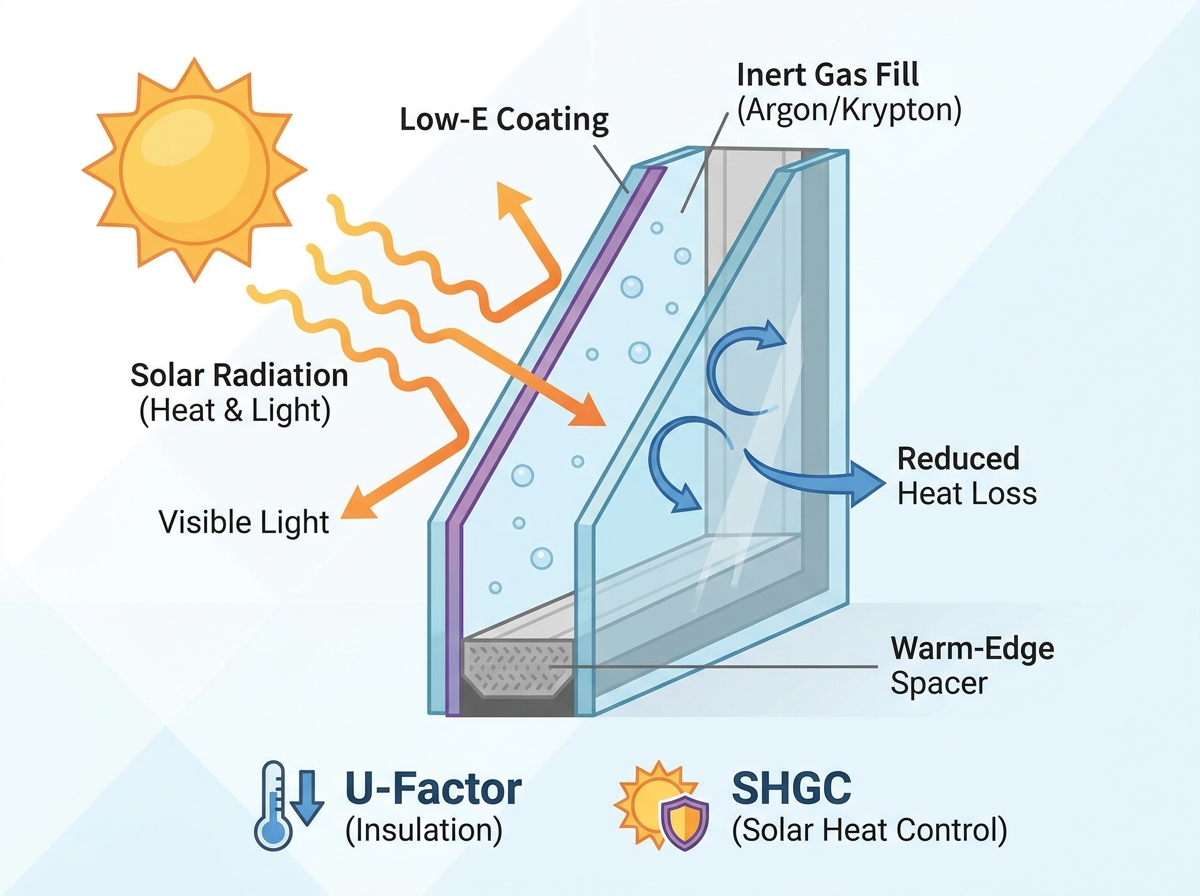
Understanding the hardware behind the metrics empowers better purchasing decisions. Modern insulated glass relies on several interacting technologies. Each component plays a distinct role in managing thermal energy.
Low-Emissivity (Low-E) coatings form the foundation of modern glass efficiency. These feature microscopic metallic layers applied directly to the glass surface. They reflect infrared heat while allowing visible light to pass freely. Selection logic requires differentiating between specific Low-E types. Passive Low-E coatings maximize solar heat gain in the North. Solar control Low-E coatings actively block solar heat in the South. Selecting the wrong coating type actively harms your home's thermal performance.
Multi-pane configurations trap air or gas to create insulation. You will mostly choose between double and triple glazing. When is the price premium of triple-pane glass actually justified? You should consider triple-pane units if you live in extreme climate zones. They provide measurable comfort improvements during brutal winters. They also offer superior acoustic control for homes near airports or highways. For moderate climates, standard double-pane units usually offer the most sensible return on investment.
Manufacturers pump inert gas fills between the panes to displace standard air. Dense gases slow thermal transfer better than regular oxygen. You will typically encounter Argon or Krypton. Argon provides the most cost-effective baseline for standard IGUs. It offers excellent performance for its price. Krypton offers better insulation in much thinner spaces. However, Krypton carries a severe cost premium. It only makes financial sense when dealing with strict architectural constraints requiring very thin window profiles.
Finally, warm-edge spacers hold the glass panes apart. Traditional aluminum spacers act as thermal bridges, pulling cold air directly to the edge of the glass. Modern structural separators utilize less conductive materials like silicone or specialized plastics. They prevent edge-of-glass condensation and significantly reduce perimeter thermal bridging. Upgrading to a premium glass package remains pointless if the manufacturer uses outdated aluminum spacers.
There is no universally perfect window. Optimal specifications change based on geography and architectural style. You must align your selections with specific environmental realities.
Climate-specific targeting requires distinct strategies. In Northern or cold climates, you must prioritize highly insulating glass. Look for the lowest possible U-Factor. Combine this with a moderate-to-high SHGC. This combination traps furnace heat inside while allowing winter sunlight to warm the house passively. In Southern or hot climates, the strategy flips completely. You must prioritize a very low SHGC. Use specialized solar control Low-E coatings to deflect intense solar radiation. This drastically reduces your daily cooling loads.
You must also understand the nuances for specific door systems. Sliding glass doors present a unique engineering challenge. They feature incredibly high glass-to-frame ratios. This much continuous glass acts as a massive thermal vulnerability.
Large-format sliding doors require stricter SHGC scrutiny than standard bedroom windows. A massive wall of glass facing the afternoon sun easily creates a "greenhouse effect" in living spaces. It will overwhelm your air conditioning system rapidly. You need aggressive solar control coatings on these specific units.
Furthermore, you must balance glass weight against operational lifespan. Heavy triple-pane glass provides excellent insulation. However, placing massive triple-pane units in a sliding door system strains the hardware. The immense weight accelerates wear on the sliding tracks and rollers. Over time, this causes operational friction and potential seal failures. Sometimes, a high-quality double-pane unit serves as a more reliable, durable choice for oversized sliding systems.
Many homeowners spend heavily on premium fenestration only to experience drafts and condensation. They fail to adopt a systemic view of the project. The most advanced glass remains functionally useless if the surrounding frame is highly conductive. Similarly, premium systems fail immediately if the installation is poorly sealed.
Integration vulnerabilities happen frequently during residential retrofits. Frame material mismatch serves as a common point of failure. Placing high-spec, gas-filled glass into a basic aluminum frame without thermal breaks creates a massive thermal bridge. The frame simply bypasses the glass's insulating properties. Improper flashing during the rough opening installation represents another major risk. If contractors fail to integrate the window into the home's water-resistive barrier, air and moisture will penetrate the wall cavity.
You must actively manage expectations around seal failures and gas leakage. Insulated glass units do not last forever. Environmental stress slowly degrades the perimeter seals. You should understand how to check for warranty coverage regarding premature condensation between panes. Moisture trapped inside the IGU indicates a complete seal failure. Once the seal breaks, the inert gas escapes, and the thermal performance plummets.
Shortlisting reputable contractors mitigates these implementation risks. Vet your installers thoroughly. You need professionals who understand advanced fenestration performance, not just basic carpentry. Ask them about their specific flashing techniques. Inquire about the types of expanding foams they use around the rough opening. Their answers will reveal whether they understand the critical nature of an airtight installation.
Selecting the right components requires carefully balancing the U-Factor and SHGC against your specific climate, architecture, and budget. Rely strictly on independent labels rather than marketing promises. Pay equal attention to the framing materials and the installation methods, as these elements ultimately dictate the glass's success.
As an actionable next step, audit your current windows to establish a performance baseline. Identify your specific ENERGY STAR climate zone requirements using government resources. Finally, always request official NFRC-certified spec sheets from your shortlisted manufacturers before signing any contracts or comparing final quotes.
A: Yes, inert gases like argon and krypton do slowly dissipate. Industry standards accept an annual diffusion rate of roughly 1%. High-quality IGUs remain highly effective for 15 to 20 years. Even after losing a portion of the gas, the combination of Low-E coatings and the remaining sealed airspace continues providing significant thermal resistance compared to standard glass.
A: Exterior condensation is actually proof your new windows are working correctly. It occurs on cool, humid mornings. Because the high-performance Low-E glass effectively prevents interior heat from escaping, the outer pane remains cool. When warm, moist outdoor air hits this cold exterior surface, condensation forms. It will evaporate as the sun rises.
A: Aftermarket films offer marginal improvements, primarily in blocking UV rays and reducing solar heat gain. However, they cannot replicate the structural thermal breaks of true IGUs. Films do not stop conductive heat loss through single-pane glass, nor do they provide the insulating benefits of an inert gas fill. They are a temporary patch, not a structural solution.
A: Upgrading from standard clear double-pane glass to a Low-E, Argon-filled package typically adds 10% to 15% to the total window cost. This premium pays for itself relatively quickly through reduced utility loads and increased interior comfort. Upgrading to exotic options like Krypton gas or triple glazing commands much higher premiums.