
English
Views: 0 Author: Site Editor Publish Time: 2026-07-27 Origin: Site


Upgrading or specifying windows for institutional environments carries unique stakes. You must balance strict municipal budgets against decades-long durability requirements. Unlike standard commercial real estate, schools and public buildings face distinct operational challenges. Facilities endure extreme high-traffic wear every single day. They also require stringent safety compliance and demand critical acoustic control to maintain focused environments. Decision-makers cannot afford frequent replacements or catastrophic performance failures.
High-quality aluminum windows for schools offer the structural rigidity needed to survive these harsh conditions. This guide breaks down the technical criteria, compliance standards, and risk-mitigation strategies you need right now. We explore how to evaluate and procure commercial-grade fixtures effectively. You will learn to navigate complex performance metrics, verify hardware grades, and choose resilient, energy-efficient solutions for public infrastructure.
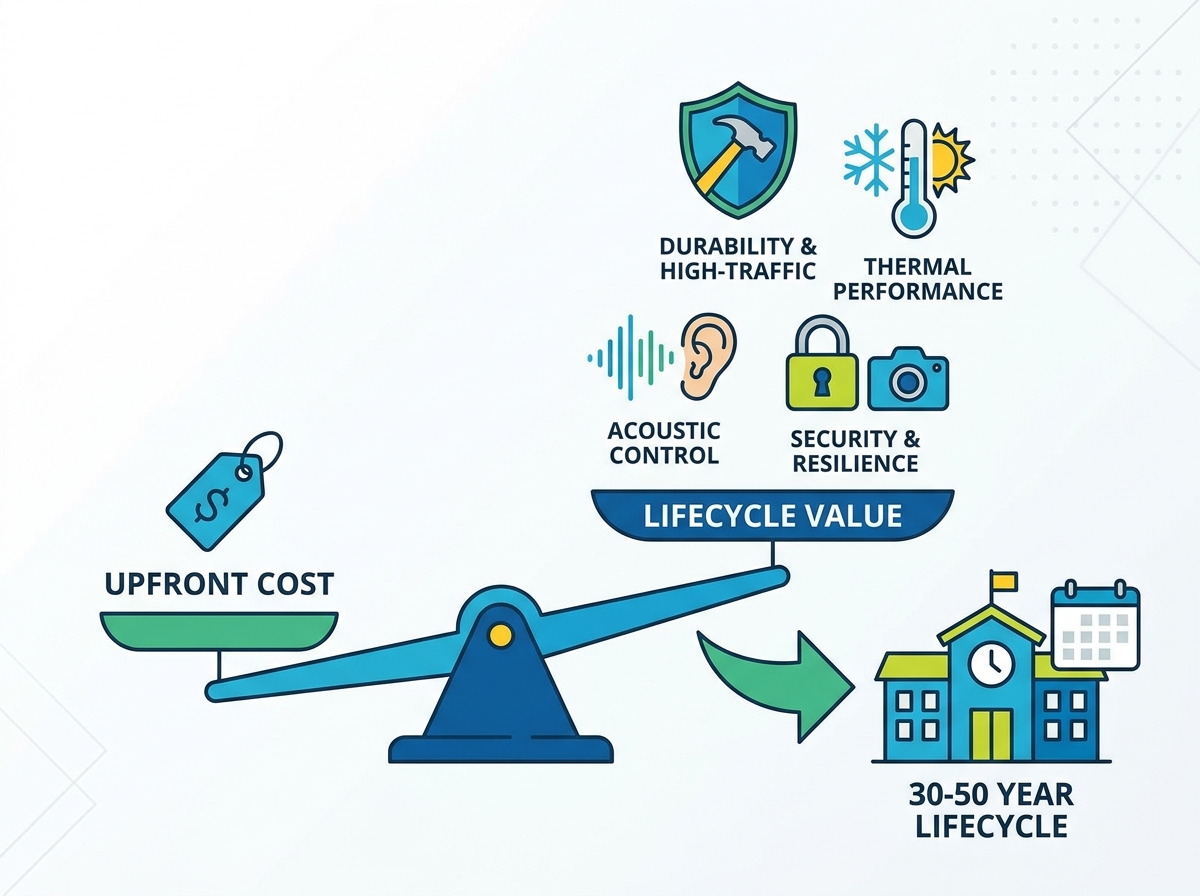
Institutional buildings demand robust infrastructure from the ground up. Upfront procurement costs only tell a fraction of the story. You must weigh initial budgets against 30-to-50-year maintenance cycles. Public funds require predictable longevity and minimal ongoing repairs. Cheaper residential or light-commercial fixtures fail rapidly in these settings. Such failures disrupt daily operations and force premature, expensive replacements.
We must clearly differentiate standard commercial use from extreme institutional wear. K-12 schools and municipal buildings see relentless daily traffic. Occupants operate fixtures aggressively and repeatedly. Standard frames dent easily, and weak corner joints separate over time. Heavy-duty aluminum extrusions provide the necessary structural rigidity. The metal naturally resists the physical abuse typical of crowded public spaces.
Hardware and operational components represent the primary points of failure. Hinges, locks, and window operators endure thousands of cycles every month. Flimsy latches strip out quickly under this pressure. Subpar hinges sag under heavy insulated sashes. You must specify heavy-duty, tamper-resistant hardware across the board. Institutional-grade parts serve as your primary defense against costly emergency work orders. Field-replaceable components also streamline routine facility maintenance. Maintenance staff can quickly swap individual parts rather than tearing out entire frames.
Aluminum presents a well-known conductivity challenge. Left untreated, the raw metal transfers heat rapidly. It leaks warm air during winter and invites unwanted heat during summer. Modern manufacturing successfully solves this natural physical disadvantage. Advanced structural engineering transforms standard aluminum into a highly efficient envelope barrier.
Thermal break technology provides the ultimate solution. Manufacturers insert a structural thermal break between the interior and exterior aluminum profiles. They typically use reinforced polyurethane or polyamide materials. This physical separation stops thermal bridging instantly. The exterior frame gets freezing cold, but the interior surface remains comfortably warm. Condensation risks drop significantly, preventing dangerous mold growth in classrooms.
You must navigate strict local energy codes during procurement. Department of Energy (DOE) guidelines mandate rigorous performance metrics for public facilities. Many municipal buildings target rigorous sustainability certifications like LEED. Meeting these government standards requires thermally broken frames as a baseline.
Glazing choices directly impact your overall energy efficiency. Large public building facades demand optimal glass configurations to balance natural light and thermal retention. You should evaluate several critical factors before finalizing specifications:
Lower U-factors indicate superior overall insulation performance. High-performance insulated glass units (IGUs) combine these advanced technologies perfectly. They turn expansive architectural openings into proactive energy-saving assets.
Thermal Configuration Comparison Matrix
| Frame Type | Thermal Break Mechanism | Recommended Glazing | Energy Efficiency Rating |
|---|---|---|---|
| Standard Commercial Aluminum | None (Direct Metal Contact) | Single or Standard Double Pane | Low (Prone to condensation) |
| Thermally Improved Aluminum | Poured-and-Debridged Polyurethane | Double Pane with Low-E | Medium (Meets basic codes) |
| Thermally Broken Aluminum | Polyamide Insulating Struts | Triple Pane or Argon-filled Low-E | High (Meets rigorous standards) |
School safety remains a paramount concern nationwide. Physical security standards require comprehensive, proactive evaluation. Forced-entry resistance stands as a top priority for ground-level installations. Heavy-duty aluminum extrusions withstand significant blunt force from potential intruders. You should combine these rigid frames with specialized impact-resistant glazing. Laminated glass and polycarbonate shields mitigate active threats effectively. They delay unauthorized access and protect vulnerable occupants during active emergencies.
Natural disaster resilience also dictates strict framing requirements. Coastal regions enforce High-Velocity Hurricane Zone (HVHZ) building codes. These areas need products rigorously rated for extreme wind pressures and flying debris. Seismic activity zones demand flexible yet highly secure structural anchoring. Heavy commercial aluminum flexes slightly without shattering during ground tremors, preserving the building envelope.
Life safety codes complicate window specifications even further. Operational fixtures must meet strict emergency egress requirements. Ground-level or basement classrooms often need designated secondary escape routes. However, upper floors require precise fall-prevention measures. You must balance easy escape mechanisms against accidental fall risks. Custodial window guards and limited-opening hardware provide a highly reliable solution. They restrict sash opening widths to a few safe inches. Authorized staff can easily bypass these limiters using special keys during fire emergencies.
Sound mitigation directly impacts institutional success and daily performance. Classroom acoustics strongly correlate with student comprehension and teacher retention. Background noise distracts learners and elevates chronic stress levels. Public worker productivity also suffers heavily in noisy municipal environments. Proper sound control blocks out wailing sirens, heavy traffic, and playground noise.
You need to understand two distinct, specialized acoustic ratings:
Achieving target decibel reductions requires a highly calculated specification matrix. You cannot rely on standard commercial glass alone to stop city noise. You must match heavy aluminum frame density to your specific acoustic goals. Acoustic engineers frequently use asymmetrical double glazing to disrupt incoming sound waves. In this configuration, one glass pane is noticeably thicker than the other. This calculated thickness difference prevents the glass panes from vibrating at the same frequency. Acoustic dampening seals and heavy inert gas fills further deaden incoming noise vibrations. A well-engineered acoustic window seamlessly transforms a chaotic urban environment into a focused, quiet sanctuary.
Sourcing durable fixtures requires strict attention to detail and extensive vendor scrutiny. Extrusion quality and wall thickness determine ultimate structural integrity. Do not accept residential or light-commercial product lines for public buildings. You should look exclusively for American Architectural Manufacturers Association (AAMA) commercial (CW) or architectural (AW) classifications. AW-rated frames feature significantly thicker walls and vastly superior corner construction. They easily handle aggressive daily use without bending or snapping.
Finish durability dictates long-term exterior aesthetics and maintenance schedules. Standard commercial paint chips and fades quickly under harsh direct sunlight. Anodized finishes penetrate the metal directly, offering excellent scratch resistance. High-performance PVDF (Kynar 500) coatings provide the ultimate long-term UV protection. They also offer surprisingly strong graffiti resistance. Maintenance crews can easily remove spray paint from PVDF surfaces using solvents without permanently damaging the base color.
Proper vendor vetting prevents costly construction delays and legal disputes. You must assess commercial window warranties very carefully. Watch out for industry red flags like limited hardware coverage or unusually short IGU lifespan guarantees. Investigate supplier lead times and overall supply chain reliability. Shipping delays can easily ruin strict summer installation schedules before the academic year begins. Choose manufacturing partners boasting a proven, verifiable track record. They need extensive hands-on experience navigating large-scale institutional installations.
Transitioning from rough specification to final procurement involves several critical next steps. Follow this logical sequence to secure the absolute best products for your facility:
Selecting reliable aluminum windows for schools and public buildings demands strategic, long-term thinking. It is never about finding the absolute cheapest bulk rate available on the market. It is about engineering a comprehensive, permanent architectural solution. You need robust systems built specifically to withstand heavy daily abuse. Your hardware choices must secure vulnerable occupants from severe external threats. Furthermore, adopting the right thermal technologies controls long-term energy costs efficiently.
We strongly encourage facility managers, municipal architects, and procurement officers to take proactive steps today. Do not settle for minimum baseline building code requirements. Schedule a comprehensive technical consultation with an experienced fenestration expert. Review product specification sheets meticulously to verify AAMA ratings and hardware grades. Request a project-specific quote tailored to your exact life-safety and energy goals. Proper technical planning today guarantees decades of reliable, safe performance tomorrow.
A: Public buildings should prioritize American Architectural Manufacturers Association (AAMA) standards. Residential grades are insufficient. You should specify Commercial (CW) or Architectural (AW) performance classes. AW-rated products feature much thicker aluminum extrusions and reinforced corners. They withstand extreme daily abuse. Always verify your chosen profiles meet the minimum wall thickness mandated by the AW classification.
A: Yes, they absolutely can. Modern aluminum frames utilize advanced polyamide thermal breaks to stop heat transfer. When combined with high-performance insulated glass units, they meet stringent energy codes. You face a worthwhile trade-off here. Aluminum offers vastly superior structural durability compared to vinyl. Achieving top-tier energy efficiency simply requires specifying these modern thermal upgrades.
A: The most frequent failures stem from the hardware trap. Cheap commercial hardware strips out or breaks under high repetition. Hinges sag, and locks jam quickly in high-traffic environments. You avoid premature replacement by specifying heavy-duty, institutional-grade hardware. Insist on field-replaceable components. This ensures facility teams can swap broken parts without replacing entire sashes.
A: Navigating this balance requires specialized hardware and integrated designs. You can utilize integrated security screens that delay exterior forced entry. Keyed custodial limiters and robust window guards restrict accidental falls. Crucially, this hardware allows for rapid interior escape. Authorized personnel or quick-release latches ensure occupants can safely exit the building during emergencies.