
English
Views: 0 Author: Site Editor Publish Time: 2026-07-16 Origin: Site


Commercial and large-scale residential projects heavily specify aluminum windows for their structural strength and modern aesthetics. However, the system's actual lifespan relies entirely on its mechanical components. Beautiful extrusions mean nothing if moving parts fail under daily stress. Sourcing cheap or mismatched components introduces severe project risks. These poor choices lead to premature mechanical failure. They create glaring security vulnerabilities. They also generate extremely expensive post-installation callbacks. Developers quickly realize replacing faulty mechanisms costs significantly more than buying quality parts initially. Selecting correct components requires balancing architectural demands against rigorous performance data. You must evaluate strict weight limits and security compliance carefully. This guide outlines a comprehensive framework for evaluating and sourcing commercial-grade systems. We will show you how to specify aluminum window hardware matching your specific extrusion profiles perfectly. You will learn actionable strategies to vet suppliers and standardize your installations.
Callbacks destroy project margins quickly. Imagine completing a large residential tower. Six months later, residents complain about drafty windows. Handles jam frequently. Hinges sag noticeably. You must send technicians to investigate every single complaint. They spend hours adjusting friction stays. They replace stripped screws. These labor costs far exceed the unit price of the failed component. Component failure ranks as the leading cause of post-completion warranty claims. We often see these common callback triggers:
Specify commercial-grade components early. You eliminate these costly site visits. You protect your baseline profitability.
Code compliance relies heavily on mechanical performance. Standard aluminum profiles cannot stop intruders alone. Robust locking points form the primary defense against forced entry. Furthermore, localized building codes mandate specific performance ratings. Coastal zones require stringent impact ratings to survive hurricane debris. Bedroom windows demand specific clear opening dimensions for emergency egress. Your hardware choices dictate whether your building passes these critical safety inspections.
Think about daily human interaction. End-users interact physically only with handles and locks. They rarely touch the glass. They do not grip the aluminum frame. A flimsy handle feels cheap. It makes the entire window feel poorly constructed. Conversely, a solid stainless steel handle turning smoothly conveys premium quality. It signals thoughtful engineering. Tenants judge the overall quality of the entire development based on these small tactile touchpoints.
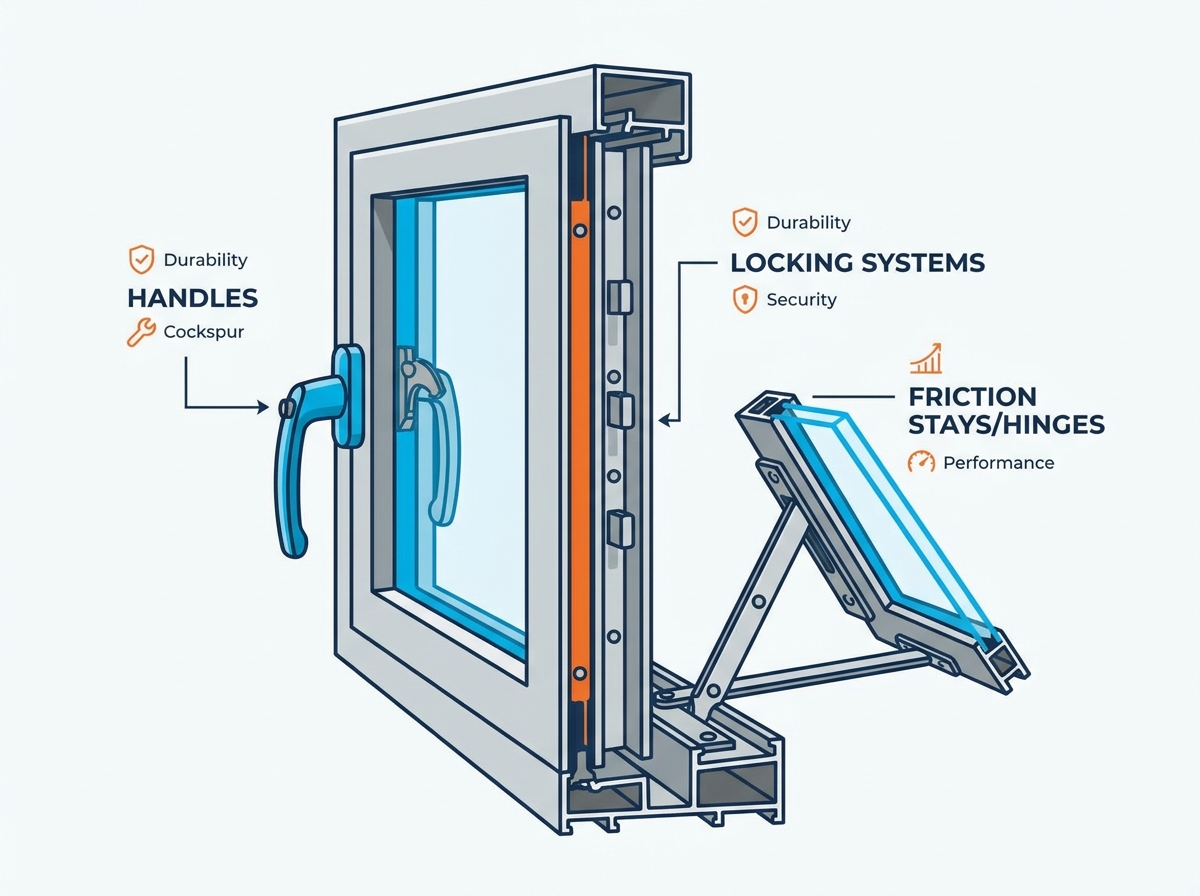
Cockspur handles secure the sash via a simple wedge mechanism. They suit older or simpler outward-opening profiles lacking internal locking channels. Espagnolette handles operate differently. They feature a protruding square spindle. This spindle drives a concealed multi-point gearbox hidden inside the frame. We strongly recommend espagnolettes for modern high-performance profiles.
Material realities matter immensely during specification. Zinc alloy offers a cost-effective solution for dry, inland climates. However, zinc degrades quickly near the ocean. Extruded aluminum matches the frame perfectly. It resists UV fading excellently. For coastal projects, you must specify 304 or 316-grade stainless steel. It provides essential defense against harsh salt environments.
| Material | Cost Level | Corrosion Resistance | Best Application |
|---|---|---|---|
| Zinc Alloy | Low | Poor to Moderate | Dry, inland residential projects |
| Extruded Aluminum | Medium | Good | Standard commercial builds |
| 304 Stainless Steel | High | Very Good | High-traffic urban areas |
| 316 Stainless Steel | Premium | Excellent | Coastal and marine environments |
Project buyers should always default to multi-point systems. Large aluminum frames flex under strong wind loads. A single-point lock secures only the center. It leaves the top and bottom corners vulnerable. Multi-point locks engage several keepers simultaneously along the sash perimeter. They pull the sash tight against the rubber weather stripping. This uniform compression improves thermal sealing drastically. It blocks drafts completely. It also upgrades forced-entry resistance significantly.
Keepers and strikes demand exact profile matching. A slight dimensional mismatch causes internal rattling. It compromises the weather seal entirely.
Load-bearing physics dictate hinge selection directly. Double and triple glazing weigh significantly more than older single panes. A modern commercial sash might weigh 80 kilograms. You must calculate exact hinge requirements based on total glass volume and density. Standard residential hinges buckle under these heavy loads. Sagging sashes scrape against the bottom frame. They eventually fail to close.
Opening angles also dictate specifications. Egress windows need 90-degree clear openings for emergency escape. High-rise windows require restricted openings for fall prevention. Some specialized friction stays feature an easy-clean mode. Users can wash the exterior glass safely from inside the building.
Good hardware undergoes rigorous cycle testing before reaching the market. Independent labs use automated pneumatic machines to open and close the sash continuously. Acceptable operational cycle thresholds vary by application. Residential components should survive at least 25,000 cycles without failure. Commercial components face heavier daily abuse. Demand 50,000 cycles or more for office buildings. We follow strict international testing frameworks. You should request EN 13126 or AAMA 904 certification documents. Verify these certificates before signing bulk orders.
Finishes dictate aesthetic longevity. Powder-coated finishes offer excellent color matching capabilities. Anodized finishes penetrate the metal surface deeply. They resist surface scratches well. PVD (Physical Vapor Deposition) provides the ultimate protective layer against harsh chemicals.
Salt-spray testing provides a transparent look at finish durability. Labs spray components continuously with a saline solution. They record exactly when red rust appears. Standard inland projects usually require 240 hours of resistance. Project buyers managing coastal developments should demand a minimum of 1,000 hours.
Ignore vague marketing adjectives. "Heavy-duty" means nothing without empirical data. Demand verifiable load-testing reports. Ask suppliers for ultimate tensile strength numbers. They must prove their components withstand extreme negative wind pressures. Testing facilities apply massive vacuum pressure to simulated window walls. They measure the exact point where locks fail. You need this hard data to satisfy structural engineers.
Compatibility issues ruin projects silently. The most common failure point involves specifying mismatched components. Hardware must match the specific extrusion channel exactly. European designs often use a standard Euro-groove. It typically measures 16mm or 20mm wide. Standardized grooves allow cross-compatibility among different international brands. You can mix and match parts easily. Custom channels trap you. If you specify parts for a custom proprietary profile, you severely limit your sourcing options.
Multi-point locks require high-precision fabrication. CNC machines must route the locking slots perfectly. A one-millimeter misalignment causes severe binding during installation. The internal gearbox grinds against the strike plate. Users force the handle to close the window. The delicate internal gears shatter. You must ensure your fabrication team understands these exceptionally tight tolerances.
Buildings stand for fifty years. Mechanical parts last maybe fifteen years. You will absolutely need replacement parts eventually. Avoid proprietary, single-source designs at all costs. If that specific manufacturer goes bankrupt, you cannot fix broken windows easily. You might have to replace the entire sash. Project buyers must prioritize open-standard mechanisms. Standardized components ensure you can source replacements from multiple vendors decades down the line.
Assess a manufacturer's true factory capacity. Many online suppliers act strictly as middlemen. They outsource production to smaller, unverified workshops. This practice fragments quality control dangerously. Ask for factory floor videos. Request CNC machine count data. Lead times stretch painfully when dealing with brokers. Direct manufacturers control their production schedules much better. They pivot faster when project deadlines compress.
Look actively for ISO 9001 certifications. However, a framed certificate alone remains insufficient. Ask for specific batch-testing documentation. Good factories pull random samples from every single production run. They test them immediately for strength and finish quality. They log this data rigorously. You have every right to request these historical logs during the vetting process.
Large property developments sometimes desire strict brand consistency. Custom-tooled handles feature unique ergonomic shapes or embossed logos. This requires expensive custom molds. It extends lead times significantly. Off-the-shelf SKUs leverage proven, existing engineering. Millions of users have already stress-tested them in the real world. We usually recommend standard SKUs for most projects. It mitigates mechanical risk entirely.
Read the fine print carefully. Manufacturers separate warranties into distinct categories. Mechanical warranties cover internal gear functions. They usually span five to ten years confidently. Finish warranties cover exterior aesthetic degradation. Sun exposure fades powder coating inevitably. Salt air pits exposed metal. Finish warranties rarely exceed one or two years in harsh coastal environments. Understand exactly what your contract covers before negotiating price.
Aluminum window components function as critical mechanical assets. They are not merely decorative afterthoughts. They dictate building security, energy efficiency, and long-term maintenance budgets. We advise buyers to prioritize precise profile compatibility above all else. Demand transparent load-bearing data. Insist on high corrosion resistance over minor upfront savings. Cheap components cost vastly more during the operational phase.
Take proactive steps today. Request technical specification sheets immediately. Ask for CAD drawings to verify extrusion fits visually. Order physical samples. Perform rigorous in-house testing before committing to a massive bulk container order. Protect your project timeline and reputation.
A: Euro-groove systems follow standardized channel dimensions, typically measuring 16mm or 20mm wide. This specific geometry ensures universal cross-compatibility among various European and international hardware brands. Standard hardware often relies on proprietary dimensions specific to one manufacturer. Choosing Euro-groove profiles allows buyers to easily swap or upgrade components from multiple suppliers without altering the aluminum extrusion.
A: Coastal environments demand extreme corrosion protection. You must prioritize components manufactured from 316-grade stainless steel. Standard zinc or 304-grade steel degrades rapidly near salt water. Look for specialized coastal-grade powder coatings or PVD finishes. Most importantly, demand manufacturer certifications proving the components passed a minimum of 1,000-hour salt-spray testing.
A: It depends heavily on the specific component. Window handles are generally easy to swap yourself if the spindle length and screw hole centers match exactly. However, internal mechanisms like concealed friction stays or multi-point lock gearboxes prove highly complex. These retrofits often require professional sash removal and precise realignment to prevent binding.
A: Yes, significantly. Double and triple-glazed units add massive weight to the window sash. Friction stays and hinges must be explicitly rated for the total calculated sash weight. Specifying underrated hinges causes the window to sag over time. This sagging prevents proper closing, destroys weather-sealing, and ultimately requires complete hinge replacement.