
English
Views: 0 Author: Site Editor Publish Time: 2026-08-15 Origin: Site


High-end residential builds demand seamless indoor-outdoor transitions. However, specifying oversized architectural openings introduces significant structural challenges. You cannot simply rely on basic commercial framing for luxury spaces. Standard commercial extrusions offer baseline durability. Yet, luxury residential applications require strict alignment regarding aesthetic criteria. They demand superior acoustic performance and advanced weather resistance. High-performance aluminum doors for villas must elevate both form and function. They must achieve this without compromising energy efficiency or security.
This guide outlines the technical specifications necessary to evaluate these systems. We explore risk mitigation strategies and strict procurement frameworks. You will learn to select optimal configurations tailored for upscale properties. We will navigate load requirements, finish standards, and installation realities together. By understanding these core principles, you can prevent costly site failures. You will ensure lasting performance across every architectural opening.
Villa designs frequently feature ceiling-height openings. Their expansive widths easily exceed standard manufacturing tolerances. You must specify heavy-duty extrusions to prevent frame warping. Thin profiles cannot handle the immense weight of oversized glass. Architectural frames must maintain strict vertical alignment over time. Gravity and structural settling constantly stress these large frames. We recommend engineering custom mullions for extreme spans. This approach mitigates twisting under heavy live loads. It ensures smooth operation across decades of daily use.
Aluminum acts as a highly effective thermal conductor. This natural conductivity presents a major design challenge. Un-insulated frames fail modern residential energy codes rapidly. They transfer exterior heat directly into conditioned living spaces. They also compromise interior comfort during cold weather. Surface condensation often forms on standard aluminum profiles. This moisture damages adjacent luxury interior finishes over time. Upgraded acoustic barriers are equally critical for luxury homes. Basic frames allow excessive exterior noise to penetrate the envelope.
Architects typically desire ultra-slim sightlines for minimal visual obstruction. However, we must balance this against physical structural requirements. Narrow frames struggle to support triple-glazed panels. They also flex under the weight of oversized insulated glass units (IGUs). Structural deflection severely impacts sliding track performance. Designers must find the optimal middle ground. You can utilize reinforced alloys to reduce visible frame thickness. This preserves the minimalist aesthetic without sacrificing necessary structural rigidity.
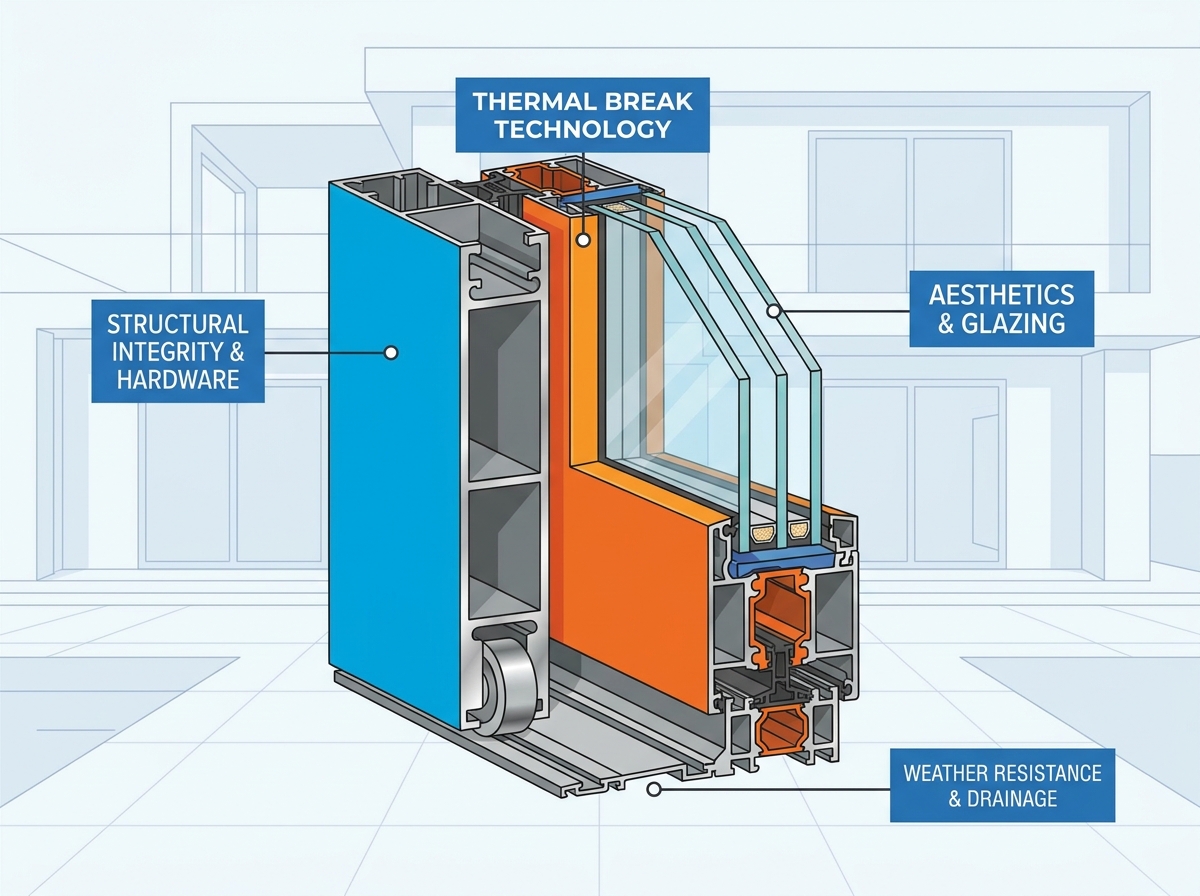
Thermal breaks represent the most critical energy efficiency component. Manufacturers insert polyamide struts between the interior and exterior aluminum extrusions. These struts physically interrupt the thermal transfer path. You must evaluate the depth and material of these struts closely. Deeper thermal breaks yield better insulation values. Specifying advanced thermal separation requirements helps meet local energy codes. It ensures you hit strict U-factor and Solar Heat Gain Coefficient (SHGC) targets. We recommend continuous structural thermal breaks for all premium installations.
You must differentiate between standard residential and architectural-grade extrusions. Basic profiles use thinner walls to reduce material costs. Architectural-grade aluminum doors for villas rely on 6063-T5 or 6063-T6 alloys. These premium alloys provide exceptional yield strength. They are absolutely necessary for long-term frame rigidity. Thicker profile walls prevent hardware pull-out over time. They also resist denting from heavy impacts. High-grade alloys maintain their structural integrity during severe weather events.
Establishing baseline requirements for surface durability protects your investment. Project location strongly dictates your finish selection. Coastal salt exposure demands the highest level of protection. You must compare powder coating against anodizing carefully. We provide a breakdown of common industry standards below.
| Finish Category | Industry Standard | Ideal Environment | Durability Characteristics |
|---|---|---|---|
| Standard Powder Coat | AAMA 2604 | Inland, low UV exposure | Moderate color retention, 5-year baseline |
| Premium Fluoropolymer | AAMA 2605 | Coastal, high UV exposure | Superior chalking resistance, 10+ year lifespan |
| Standard Anodized | Class II | Mild interior/exterior | Basic scratch resistance, porous surface |
| High-Performance Anodized | Class I | Harsh coastal zones | Deep oxide layer, exceptional corrosion defense |
Hardware selection dictates the daily tactile experience of the door. You should specify stainless steel multi-point locking mechanisms exclusively. These locks secure oversized panels tightly against weather stripping. Heavy-duty precision rollers are mandatory for massive sliding units. Rollers must carry ratings for 500+ lbs per panel easily. Substandard rollers will crush under heavy IGUs within months. We advise verifying third-party cycle testing data. This data proves the hardware can withstand decades of continuous operation.
Lift-and-slide doors remain the industry standard for oversized spans. You turn the handle to lift the massive panel physically. This engages the heavy-duty rollers beneath the frame. The mechanism allows effortless movement of thousand-pound panels. Closing the handle drops the panel back onto the track. This action compresses the specialized weather sealing gaskets completely. It provides superior weather sealing and unmatched structural stability. These systems easily outperform traditional friction-based sliding doors.
Bifold systems open entire walls to the outdoors seamlessly. You must assess their load-bearing requirements carefully. Top-hung systems require massive structural steel headers above. Bottom-rolling systems transfer the weight to the floor slab instead. You must also consider the spatial implications of stacked panels. Folded door leaves protrude into interior or exterior living spaces. Thoughtful layout planning prevents these stacks from obstructing pathways. We suggest specifying odd-numbered panel configurations for easier daily access.
Pivot doors serve best as dramatic, statement entryways. They rotate on a vertical axis rather than side hinges. Their immense size requires specialized hydraulic pivot hardware. These hydraulic hinges control the opening and closing speed safely. You must integrate multi-point locks along the door perimeter. This prevents top-corner bowing caused by extreme temperature differentials. Proper weather stripping remains a challenge for pivot configurations. You must demand automatic drop-down bottom seals for exterior applications.
Minimalist sliding doors maximize unobstructed glass areas beautifully. Installers embed the structural aluminum frame directly into the walls. They conceal the tracks flush within floors and ceilings. Only the central vertical mullions remain visible to the eye. This configuration demands absolute precision during the framing stage. The surrounding building structure must handle all deflection loads perfectly. Any structural sagging will instantly bind the concealed sliding mechanisms. These systems offer unparalleled modern aesthetics when executed flawlessly.
You must align design pressures with local building codes. Design Pressure (DP) ratings dictate the system's structural limits. High-wind zones demand heavily reinforced vertical mullions. Hurricane regions require impact-resistant laminated glass packages. Upgraded aluminum doors for villas prevent catastrophic envelope failures during storms. Engineers calculate both positive and negative wind pressure requirements. You must review these calculations before authorizing frame production. Skipping this review often leads to failed local inspections.
Flush-sill thresholds create seamless transitions between indoor and outdoor spaces. However, they complicate bulk water management significantly. You must specify integrated sub-sill drainage systems beneath the tracks. These hidden channels divert water away from the interior efficiently. They prevent water ingress even during severe driving rain. You must achieve this without compromising accessibility standards. Proper slope detailing ensures compliance with ADA accessibility guidelines. Always verify the water penetration resistance test reports.
Luxury villas require serene, quiet interior environments. You should pair aluminum frames with specialized laminated or acoustic glass. This combination effectively mitigates exterior noise pollution. Sound Transmission Class (STC) ratings measure interior voice insulation. Outdoor-Indoor Transmission Class (OITC) ratings measure low-frequency exterior noise. High OITC ratings are essential for urban or high-traffic villa locations. Thick, asymmetrical glass panes disrupt sound wave frequencies best. Acoustic PVB interlayers provide the final barrier against noise.
Security remains paramount for high-net-worth residential properties. You must evaluate the embedded locking points carefully. Anti-lift pins prevent intruders from prying panels off their tracks. Heavy-duty striker plates resist violent forced entry attempts. Premium systems utilize hook-shaped locking bolts made of hardened steel. We recommend verifying performance against standard residential security testing protocols. Products should pass stringent forced entry resistance standards easily. Laminated glass adds another critical layer of physical security.
Successful installations begin long before the doors reach the site. You must engineer rigid load-bearing headers above the openings. These headers must prevent any downward structural deflection completely. Even minor deflection will instantly jam sliding and bifold mechanisms. The building structure must not rest any weight on the door frames. We advise setting strict deflection limits during the framing phase. Clear communication with the structural engineer prevents costly on-site rework.
Oversized architectural doors involve extreme physical weights. You must factor in the complex logistics of transporting these units. Maneuvering 1000+ lb glass panels requires specialized lifting equipment. Remote or complex villa sites complicate crane access significantly. You must plan secure staging areas for the materials upon delivery. We suggest pre-glazing smaller panels in the factory when possible. However, mammoth panels always require dangerous on-site glazing procedures.
High-performance aluminum doors require perfectly plumb and level rough openings. They fail quickly due to out-of-plumb framing structures. Standard framing crews often lack the necessary precision for architectural doors. The requirement for specialized installers certified by the manufacturer is absolute. Certified teams understand the specific shimming and sealing protocols required. They ensure the track sits perfectly flat across expansive widths. Poor installation voids manufacturer warranties almost immediately.
Premium hardware requires regular, documented maintenance to perform flawlessly. You must set realistic expectations for clients regarding coastal properties. Airborne salt accelerates the degradation of moving parts rapidly. You should establish strict hardware lubrication and track clearing routines. Finish cleaning protocols preserve the surface warranty over time. Neglecting routine maintenance leads to premature roller failure. We recommend outlining a biannual maintenance schedule for the property manager.
Do not accept basic manufacturer marketing claims at face value. You must demand independent, third-party testing documentation. We recommend requesting NFRC and AAMA certification reports upfront. Structural test reports validate the internal engineering of the frames. Reviewing physical test data separates premium suppliers from basic fabricators. It proves the systems can handle the specific demands of your project. We outline a clear procurement verification sequence below.
Analyzing the fine print of a vendor's warranty is crucial. You must check for hidden geographical exclusions carefully. Many standard warranties void coverage if installed within two miles of salt water. You must distinguish between the frame, hardware, and glass warranties. Hardware warranties often expire years before the frame finish warranty. You must negotiate enhanced coastal coverage when building near the ocean. Clear warranty terms protect the client from future liability.
Prioritize manufacturers who provide comprehensive custom engineering support. They should supply detailed shop drawings for every unique oversized unit. We highly recommend requesting physical corner sample mock-ups. These mock-ups allow you to verify the finish quality and profile dimensions. They help you visualize the thermal break integration firsthand. Reviewing mock-ups prior to order finalization eliminates aesthetic surprises. Strong engineering support proves the supplier understands complex architectural execution.
Architectural aluminum doors require significant production timeframes. You must factor in 12-to-20-week lead times for custom architectural profiles. Premium European hardware imports often face unpredictable shipping delays. Expediting these massive assemblies is rarely possible once ordered. You must finalize door specifications early in the construction sequence. Delays in door procurement will halt the entire building dry-in process. We advise padding your supply chain schedule by several weeks.
Specifying aluminum doors for villas requires looking past basic aesthetics. You must evaluate structural limits, thermal break engineering, and hardware durability comprehensively. High-end residential projects demand flawless execution from the initial design phase through final installation. Deflection issues, thermal bridging, and poor weather sealing will ruin a luxury space quickly. You must prioritize deep technical verification over simple visual appeal.
Base your final vendor selection on certified performance data and warranty transparency. Evaluate the manufacturer's proven ability to support complex site-specific engineering requirements. Their technical support is just as vital as their product quality. Taking a rigorous, evidence-based approach ensures long-term operational success.
Take action today to secure the integrity of your villa project. Request a specialized technical consultation from your preferred manufacturer. Download standard CSI MasterFormat Div 8 specification sheets to build your documentation. Finally, submit your project elevations for a comprehensive structural engineering review.
A: No. Standard aluminum conducts heat. Villa projects must specify "thermally broken" frames with insulated glass to meet energy codes and prevent condensation.
A: While standard panels max out around 5-6 feet, architectural lift-and-slide systems can accommodate panels up to 10-12 feet wide, provided the structural header and track hardware are engineered for the extreme weight.
A: Pivot doors lack traditional side jamb stops. High-end specifications resolve this by utilizing automatic drop-down bottom seals and multi-point locking systems that engage the top and bottom of the frame simultaneously.
A: Avoid standard powder coats. Specify either a Class I anodized finish or an AAMA 2605 certified fluoropolymer (PVDF/Kynar) coating to prevent salt-induced pitting and corrosion.